It sounds like a simple question, but if you look closely it reveals something about the kind of person you are. Some people organize their lives around reducing uncertainty. They want clear instructions, reliable systems, predictable outcomes.
And then there are the others.
The ones who are drawn toward uncertainty.
History, if you look at it carefully, belongs almost entirely to that second group.
But if you stretch your view back far enough, risk begins to look less like an exception and more like the default setting of our species. For most of our existence, the world did not present itself as a series of guarantees. It presented signals. Clues scattered across landscapes that hinted at possibilities.
A patch of greener vegetation suggesting water beneath the soil.
A flock of birds moving in a particular direction, hinting at land over the horizon.
A bend in a river where heavy minerals accumulated in the gravel.
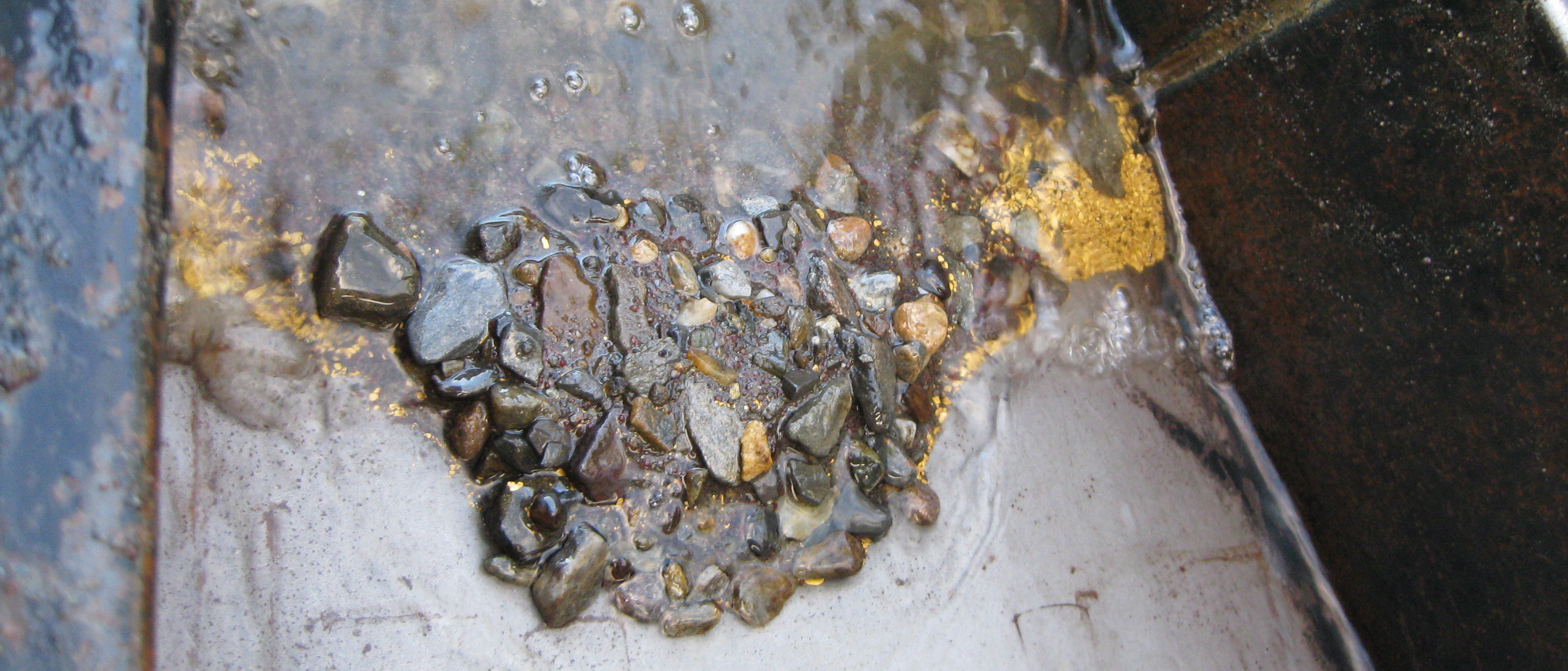
Or a faint glimmer in a pan that might be gold.
The people who noticed those signals survived and prospered. Over time, the habit of searching became something deeper than strategy. It became part of how the human brain works. To understand that instinct, it helps to begin somewhere small.
Why do children prefer to hunt for Easter eggs instead of simply being handed the chocolate?
The chocolate is identical either way. The outcome is identical. Yet the moment the eggs are hidden, the yard transforms into something different.
Children move across it like explorers.
They scan the grass. They check behind bushes and beneath benches. Their attention sharpens. They notice flashes of color others miss.
The hunt becomes the experience. And when one of them finds an egg, the excitement that follows is strikingly intense for something wrapped in foil. Because what the child has discovered is not simply chocolate.
They have revealed something hidden.
That moment activates a very old circuit in the brain. Neuroscientists studying motivation have discovered that dopamine, the neurotransmitter commonly associated with pleasure, behaves in a curious way. It does not primarily spike after a reward arrives. It spikes when the brain detects the possibility of reward. The key word is possibility.
When something valuable might exist in the environment, dopamine rises sharply. Attention narrows. Curiosity intensifies. The brain prepares to search.
This is sometimes called the exploration circuit. It links dopamine producing neurons in the midbrain with areas of the cortex responsible for planning and attention. When uncertainty combines with potential opportunity, the system activates.
The result is a powerful feeling that explorers across history have described in remarkably similar terms.
Curiosity.
Anticipation.
The sense that something might be just ahead.
Which brings us to gold.
Gold has always had a peculiar ability to pull explorers into unknown landscapes. Unlike many resources, gold rarely sits out in the open. It hides in subtle geological patterns. It collects in ancient riverbeds, bedrock cracks, and layers of gravel shaped by long forgotten floods.
Finding it requires attention.
It requires reading the landscape.
And it requires persistence.
Long before the Klondike, explorers searching for gold reshaped an entire continent.
When Spanish explorers arrived in the Americas in the sixteenth century, they carried with them stories of immense wealth hidden somewhere in the interior. The legend became known as El Dorado, the lost city of gold.
Whether the city actually existed mattered less than the possibility that it might.
Expeditions pushed deeper into jungles and across mountain ranges searching for it. In the process they mapped rivers, crossed the Andes, and encountered civilizations like the Inca.
The Inca themselves had mastered a sophisticated relationship with gold. For them it was not currency but something closer to sunlight made solid, a sacred material used in temples and ceremonial objects.
The Spanish saw it differently.
To them it represented wealth.
And so they developed strategies for finding it. They followed river systems inland, studying the way water moved through landscapes. They learned that gold tended to settle in certain places: inside bends of rivers, behind obstacles, and in layers of gravel where heavy minerals accumulated. They also left us some of the vocabulary miners still use today.
Placer deposits are concentrations of heavy minerals like gold that accumulate in sediments through the action of water.
The word placer comes from Spanish.
It shares its linguistic root with the word for pleasure.
There is something quietly fitting about that connection. The pleasure of finding placer gold is not only in the gold itself. It is in the act of finding it.
the capture of Atahualpa (r. 1532-33),
The gold rushes of the nineteenth century followed a pattern that now feels almost inevitable. A small discovery would be made, often by a handful of prospectors working a creek, and the news would begin to travel. At first slowly, then all at once. Within weeks or months thousands of people would be moving toward a place most of them had never seen.
It began in California in 1848 at Sutter’s Mill. Soon the rivers of the Sierra foothills filled with miners crouched along gravel bars, panning and sluicing. Ships arrived in San Francisco only to have their crews abandon them for the diggings.
The pattern repeated itself again and again across the west.
In 1858 gold was discovered along the Fraser River in British Columbia, and prospectors rushed up the canyon testing every bar of gravel they could reach. The search pushed deeper into the interior during the Cariboo rush, where camps like Barkerville appeared almost overnight. When new discoveries were made in the Cassiar and later the Omineca districts, the frontier shifted again, following the signals of gold farther north.
When gold was discovered in the Yukon in 1896, tens of thousands of people began traveling north. They crossed mountain passes carrying enormous loads of supplies. They built camps along frozen creeks and dug shafts through permafrost.
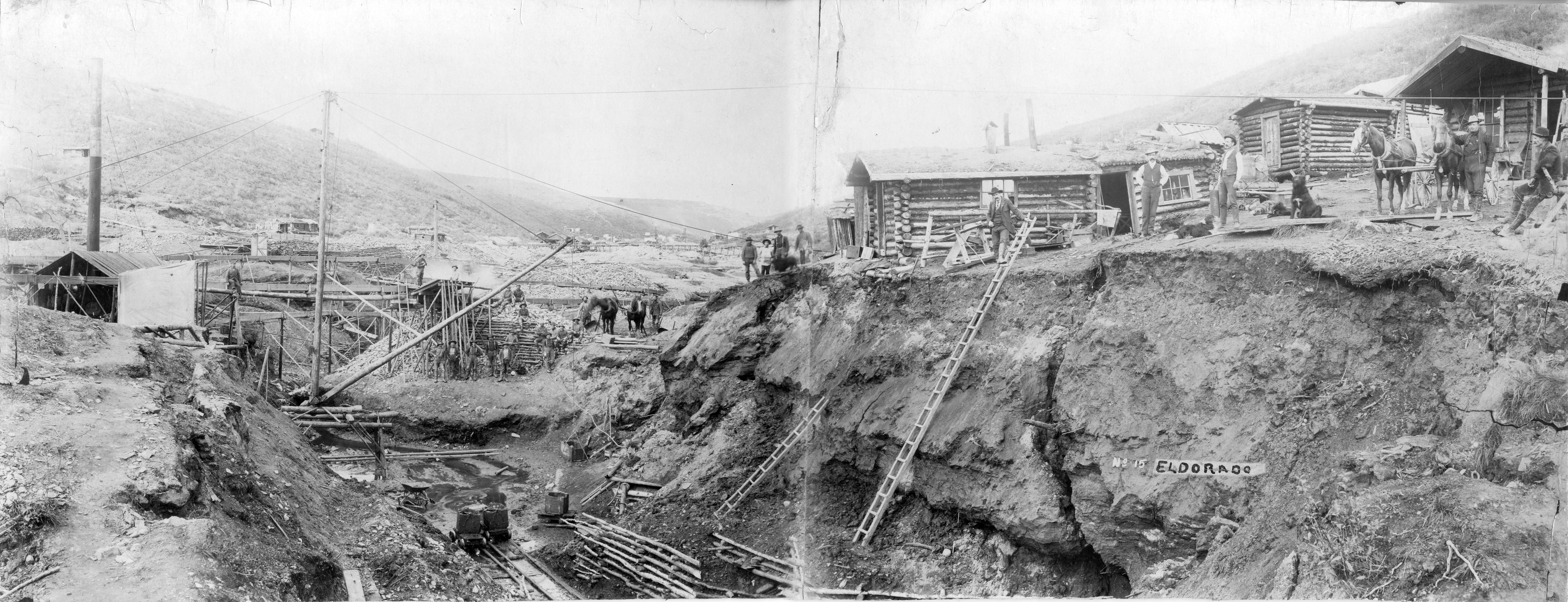
The earliest miners focused on the creek bottoms of Bonanza and Eldorado. There they found astonishingly rich deposits of gold concentrated in the gravel.
But the story did not end there.
The first miners had found the obvious gold.
The gold that was easiest to see.
More experienced prospectors began noticing something else. The hills above the creeks contained layers of gravel that did not belong to the modern river system.
Old rivers that had once flowed across the landscape at higher elevations before erosion carved the valleys deeper.
One of the prospectors who recognized this was “Caribou Bill” Seathing, a veteran of earlier northern mining camps in the Cariboo and Cassiar districts. Seathing understood that if those ancient rivers had carried gold, their gravels might still contain it. So he began exploring the hills above Bonanza Creek. And he found gold there too.
This discovery sparked a second wave of exploration across the hillsides overlooking the valley. Miners began referring to these areas collectively as the hills of Bonanza. Among the most famous were Cheechako Hill, Gold Hill, French Hill, and Adams Hill.
The names themselves tell part of the story.
Cheechako was the northern nickname for newcomers who lacked experience. The joke was that only a cheechako would dig on the hillside instead of the creek. Until they hit rich ground.
Gold Hill quickly became one of the richest bench deposits in the district.
French Hill was heavily worked by French Canadian miners.
Adams Hill revealed another fragment of the ancient river system.
Geologically the picture became clear.
An older Bonanza River had once flowed at a higher elevation, depositing gold within its gravels. Later erosion carved the valley deeper, leaving pieces of that original channel stranded along the hillsides.
Below them, the modern creeks continued cutting downward. The result was a layered placer system. Deep creek pay streaks. Bench gravels halfway up the valley. High channel remnants perched along the hills.
The miners who discovered the hills were not simply lucky.
They were paying attention.
They were following signals in the landscape.
And they continued searching after others believed the gold had already been found.
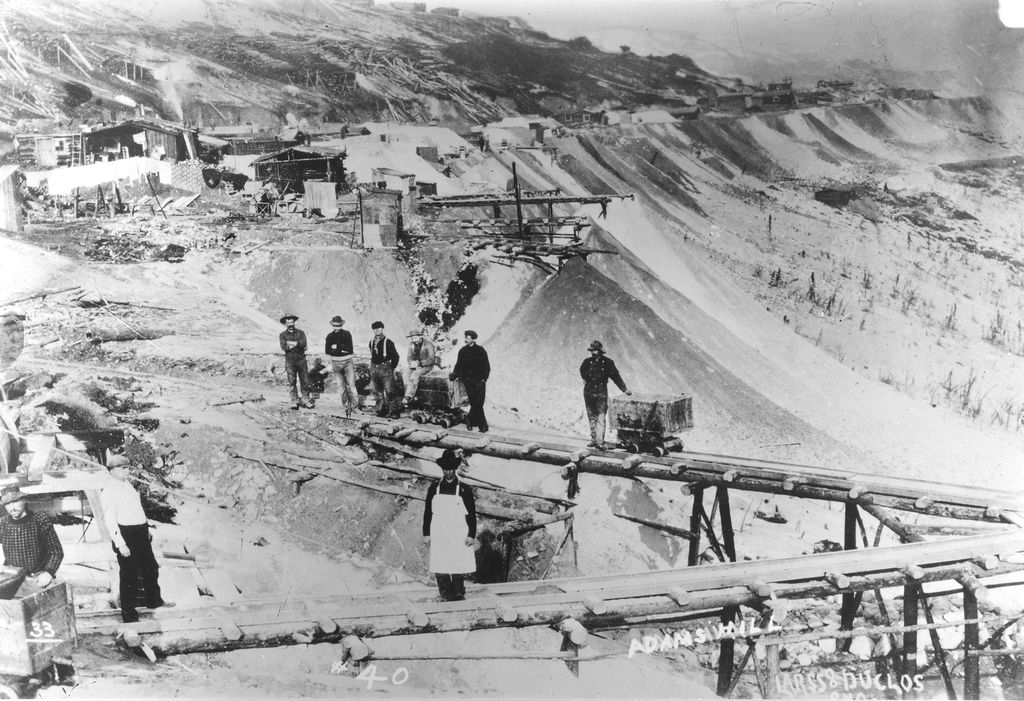
Mining operations on Adams Hill, Klondike (circa 1900)
That pattern repeats across every frontier humans explore.
Take the search for the Titanic.
When oceanographer Robert Ballard set out to locate the wreck in 1985, the search area in the North Atlantic was enormous. Looking directly for the ship would have been like searching for a needle in a dark ocean.
So Ballard changed the strategy.
Instead of searching for the ship, he searched for the debris field that must surround it.
A camera sled was lowered to the ocean floor and the support ship began moving in a grid pattern, sweeping the seabed strip by strip, much like mowing a lawn.
Ballard spent weeks scanning empty seabed. Then suddenly something appeared.
A boiler.
A signal.
Following the debris trail eventually led to the wreck itself. The discovery looked dramatic when it appeared on television. But it was built on patient strategy.
Search the grid.
Follow the clues.
Space exploration uses similar logic.
Astronomers rarely see distant planets directly. Instead they search for subtle signals in the light of distant stars. If a planet passes in front of a star, the star’s brightness dims slightly. If a planet tugs on a star gravitationally, the star wobbles.
These tiny signals reveal worlds that would otherwise remain invisible.
Even the search patterns used by planetary rovers on Mars resemble grid exploration. Instruments scan the terrain methodically, sampling soil, analyzing rock chemistry, and building maps that reveal patterns beneath the surface.
Across oceans, planets, and river valleys, exploration follows a surprisingly similar structure.
Look for signals.
Search systematically.
Follow anomalies.
The creeks of the Klondike have been mined for more than a century. Yet new discoveries still happen. Modern geophysicists and geologists now use tools that earlier miners could never have imagined.
GIS mapping allows explorers to reconstruct ancient landscapes from digital elevation models. Satellite imagery reveals subtle features in terrain that hint at buried river systems. And new geophysical techniques allow explorers to see beneath the surface without digging.
One example is HVSR (horizontal to vertical spectral ratio analysis) seismic technology that we use today. Instruments placed on the ground record natural vibrations in the Earth. By analyzing those vibrations, geophysicists can estimate the depth of sediment and the shape of bedrock beneath it.
Ancient river channels often appear as deep troughs carved into bedrock and filled with gravel. In other words, the buried rivers that carried gold thousands or millions of years ago can still be mapped. Even in landscapes that have been mined for over a hundred years.
Exploration is not only about tools or techniques. It is about a way of seeing.
The philosopher William James once wrote that attention determines our experience of reality. It is a deceptively simple idea. The world around us contains vastly more information than any brain could possibly process. Every moment carries an overwhelming flood of sights, sounds, textures, movements, patterns, and possibilities. If we tried to absorb all of it at once, our minds would collapse under the weight of it.
So the brain solves the problem with a kind of ruthless efficiency.
It filters.
James described attention as the process by which the mind selects one small portion of reality and elevates it above the rest. Everything else fades into the background. Not because it disappears, but because we stop noticing it.
Explorers notice differently.
They linger on anomalies.
They follow faint patterns.
They move toward uncertainty instead of away from it.
And sometimes, when those signals are followed far enough, they discover something extraordinary.
Gold in a hillside.
A shipwreck beneath the sea.
A reef in the ocean.
A planet orbiting a distant star.
When the eggs are hidden, the lawn becomes a landscape of possibility. The children spread out across it scanning for clues.
A flash of color. A shape in the grass. Then suddenly someone sees something.
Discovery.
In that moment something ancient in the brain settles into place. The possibility that first caught the mind’s attention has turned into something real. A signal has become a finding.
The experience is strangely universal. A child lifting an egg from the grass. A prospector watching a bright fleck of gold appear in the bottom of a pan. An oceanographer noticing a shape on the seafloor that turns out to be a ship lost for a century. An astronomer seeing the faint dimming of a star that reveals a planet no one has ever seen.
Different landscapes. But the same instinct.
Humans have always been drawn toward places where the pattern of the world suggests something more might be there.
And somewhere, in a valley shaped by an ancient river and now traced by modern instruments, the next discovery is already part of the landscape.
Waiting for someone curious enough to start looking.
There are many different types of washplants on the market today. The one thing that they all have in common is that everyone says theirs is the best! We’re not setting out to prove which plant is the best, this article will explore different types of plants and their strengths and weaknesses. Different plants are suitable for different conditions. There is no one size fits all solution.
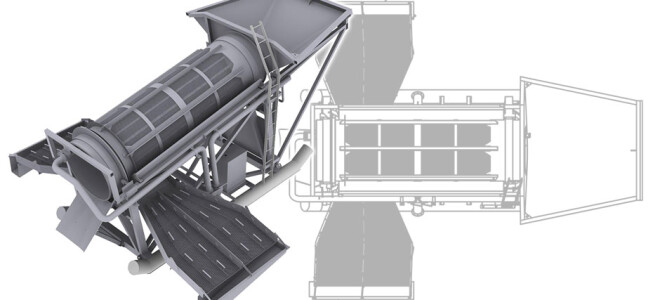
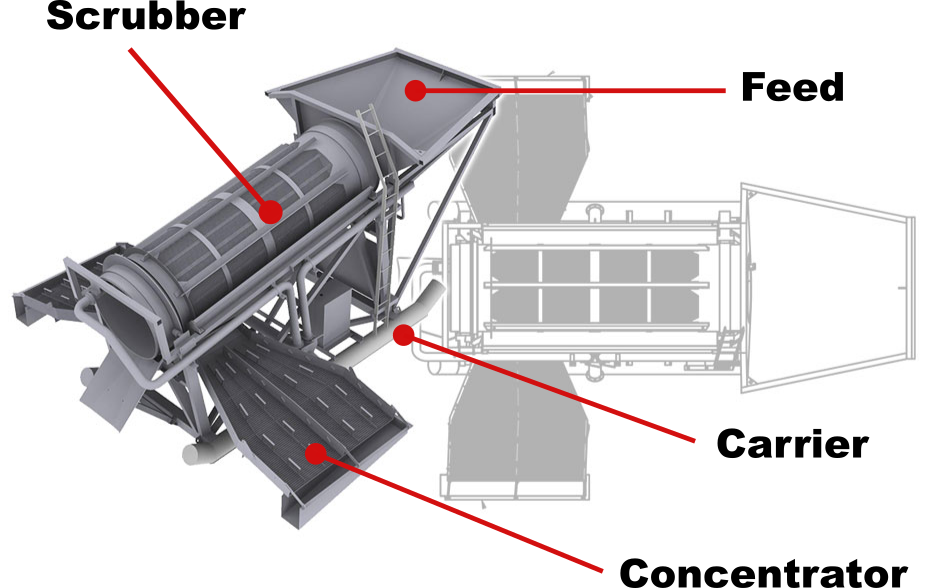
There are 4 main components to a wash plant: Scrubber, Concentrator, Feed System, and Carrier. While no two wash plants are identical they all involve a combination of these 4 components.
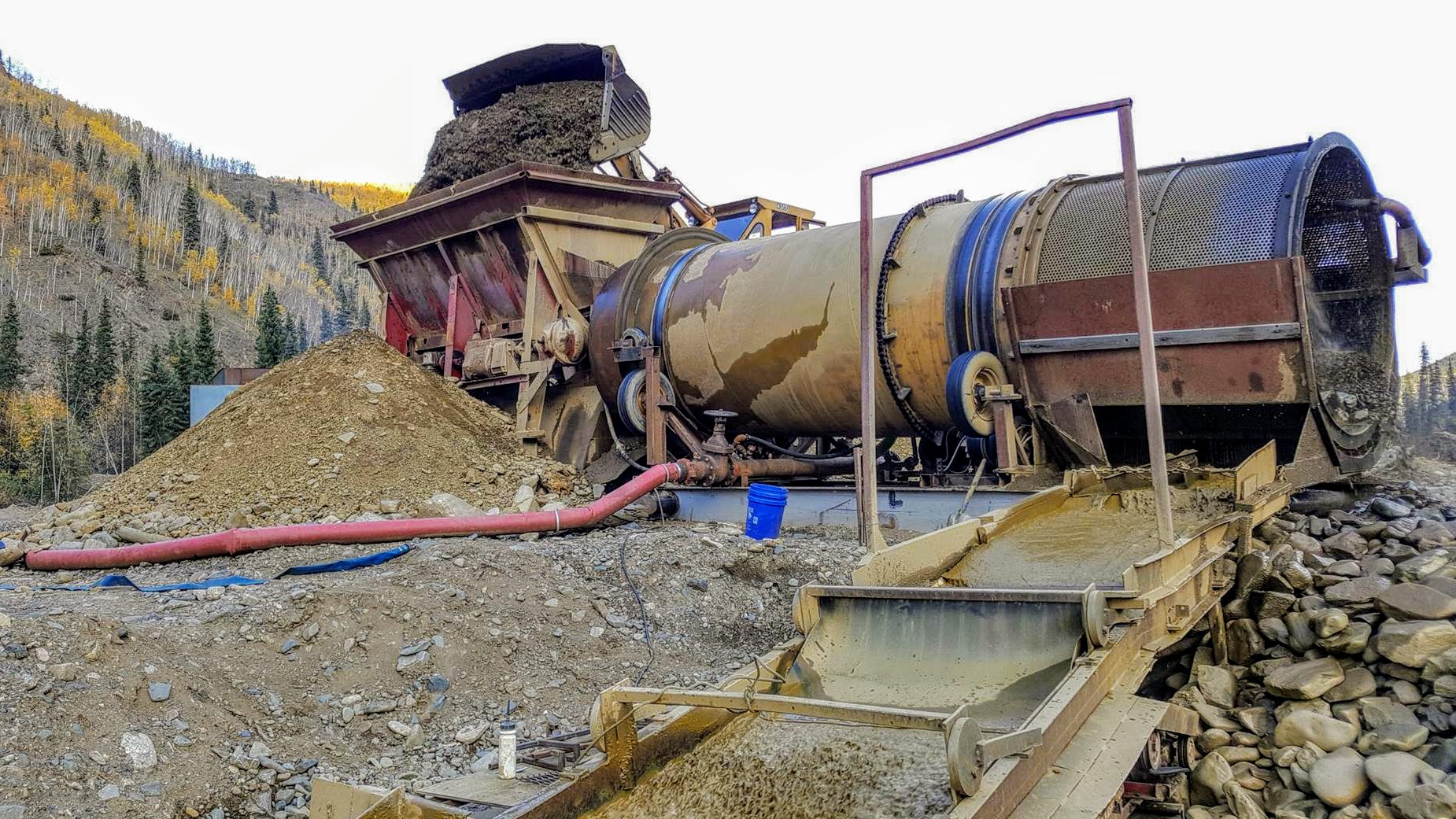
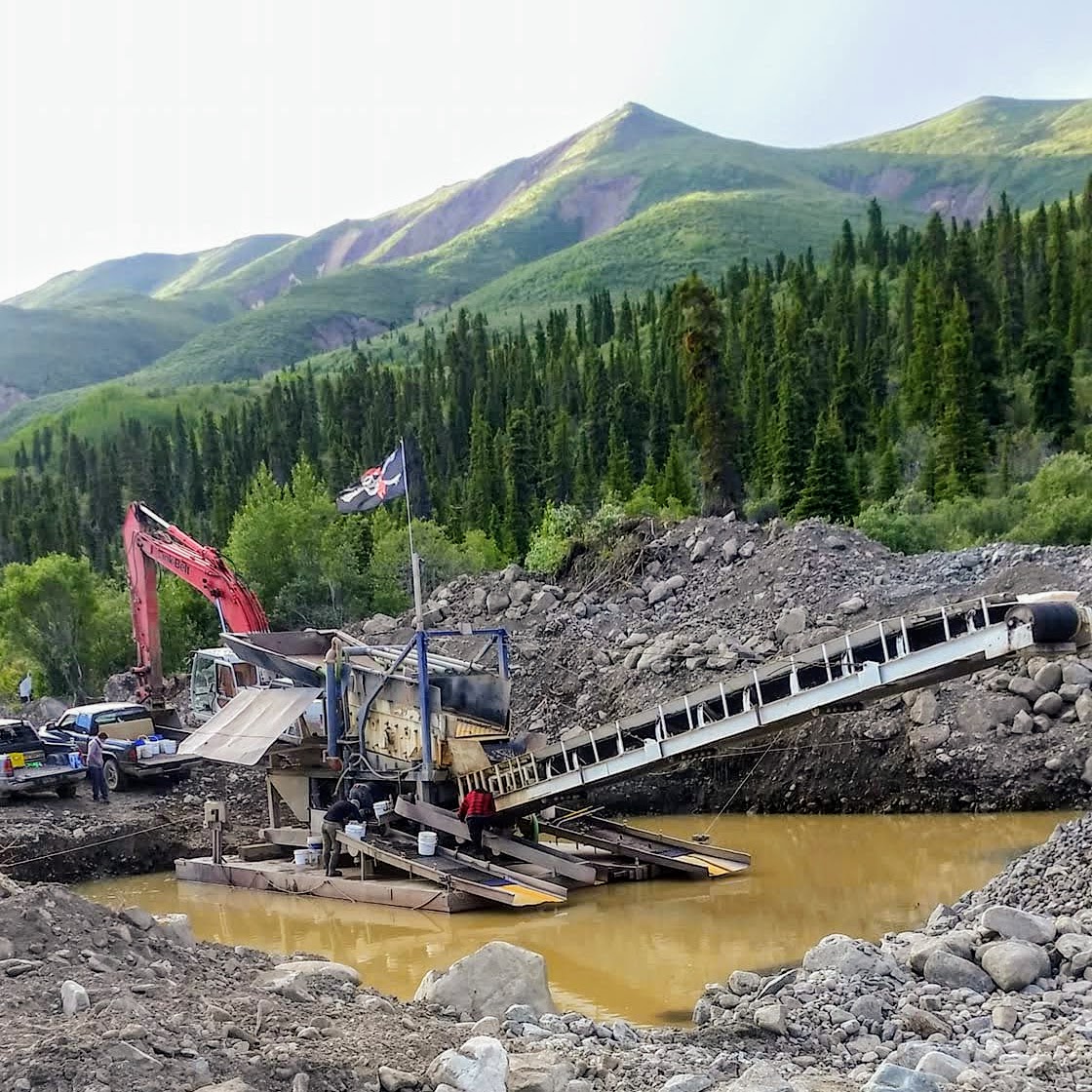
Take a typical trommel plant that you would find in BC or the Yukon for example. You’ll have a hopper that is fed by an excavator, a trommel that feeds a sluice box and it’s mounted on skids.
Scrubbers
The scrubber is the component of a wash plant that separates raw material and prepares it for concentration. The scrubber will remove large rocks and break down chunks of clay and packed sand. Most scrubber systems use water jets to wash the gravel to remove the fine gold that is attached to the cobbles.
The sand and clay that adheres to pebbles and rocks has been shown to have much higher gold content than the gravel as a whole. For that reason, it is important to wash your material well so that gold can be captured in the concentrator.
The scrubber has three main functions:
Separate large cobbles and boulders from the feed gravel
Wash the cobbles and gravel
Break up clods of agglomerated material
The five categories of scrubbers in use today are the Screen Deck, Trommel, Reverse Trommel, Derocker, and Grizzly.
Trommels
Trommels use a rotating drum to agitate the material. Raw gravel is fed at one end and passes over openings in the drum. Rocks that are larger than the openings are disposed of as tailings. The drum is set at a slight angle to allow the tailing rocks to work their way off the end. Trommels do an excellent job of breaking up clay, mud, and compacted gravels.
A trommel is driven by an electric or gasoline-powered motor. The motor spins the drum by either using a long chain with cogs welded around the drum or by wheels that the drum sits on. Most trommels will have a spray bar running inside the drum that sprays high-pressure water on the gravel to aid in removing gold particles from the rocks. The trommel has a lot of moving parts which is one drawback. The more complex a system is, there more potential for failure.
In North America trommels are most often paired with a sluice box that is positioned at a right angle to the drum. A section of openings are positioned above the sluice box with metal screens to allow specific sizes of particles through. Each mine has different requirements for particle sizes depending on the size of gold that exists there. Miner’s typically have openings of 1/2″ or 3/4″, the size of the opening depends on the distribution of gold sizes in the pay gravels.
Trommels can be paired with any type of concentrator, it doesn’t have to be a sluice. Trommels can be any size. They vary from the Gold Cube trommel which is 5” in diameter and 16” long to plants that can run hundreds of yards per hour with diameters of 8 feet or more. Trommels are relatively easy to set up and can handle a wide range of materials. The big advantage that they have over other scrubbers is the ability to break up cemented or compacted material.
Pros
Cons
Can handle different kinds of material
Mechanically complex, requires maintenance
Can handle high volume
Large footprint
Relatively easy setup
Burn a lot of fuel
Breaks up clay and compacted gravel
Large trommels are difficult to move
Screen Decks
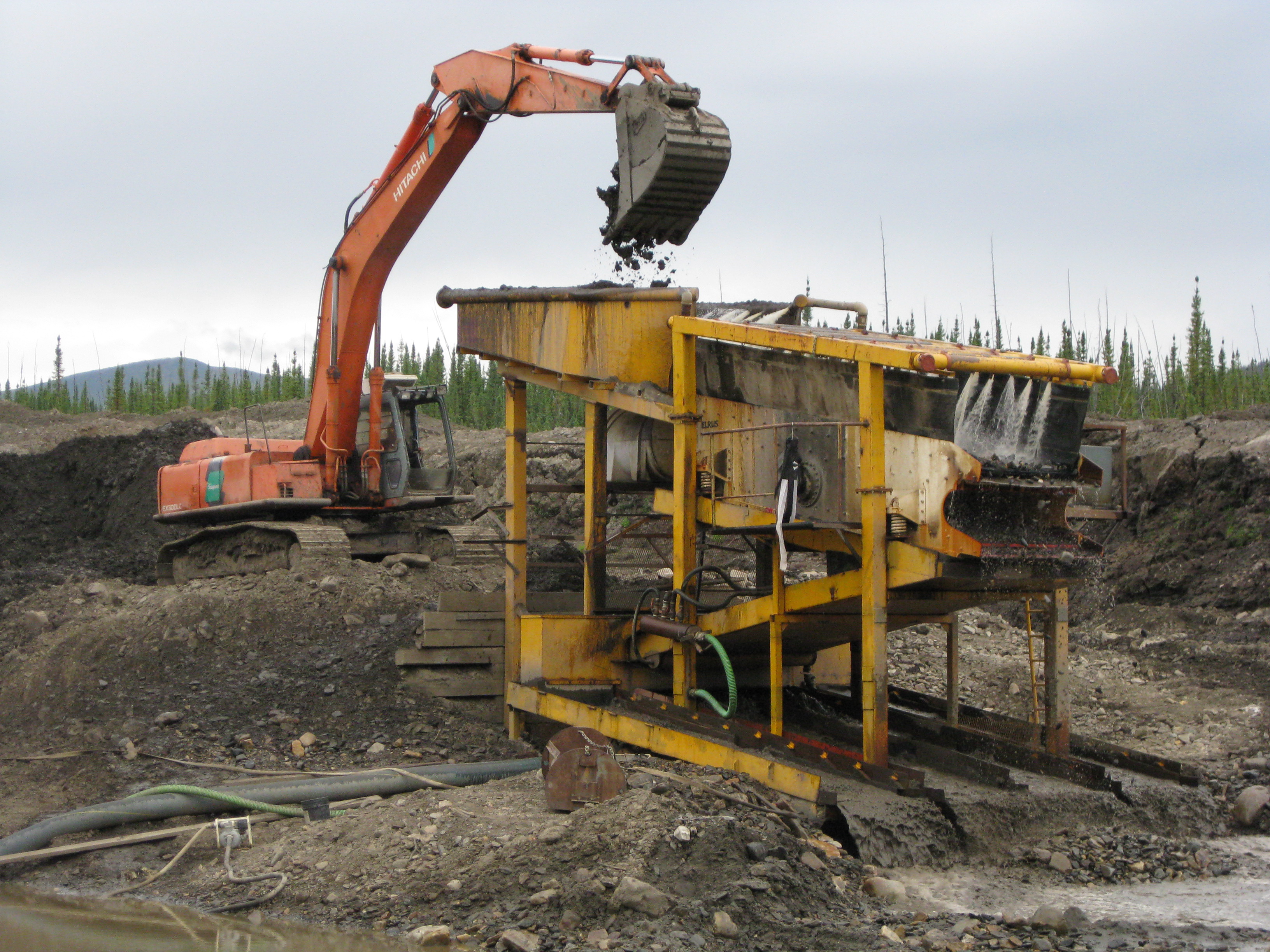
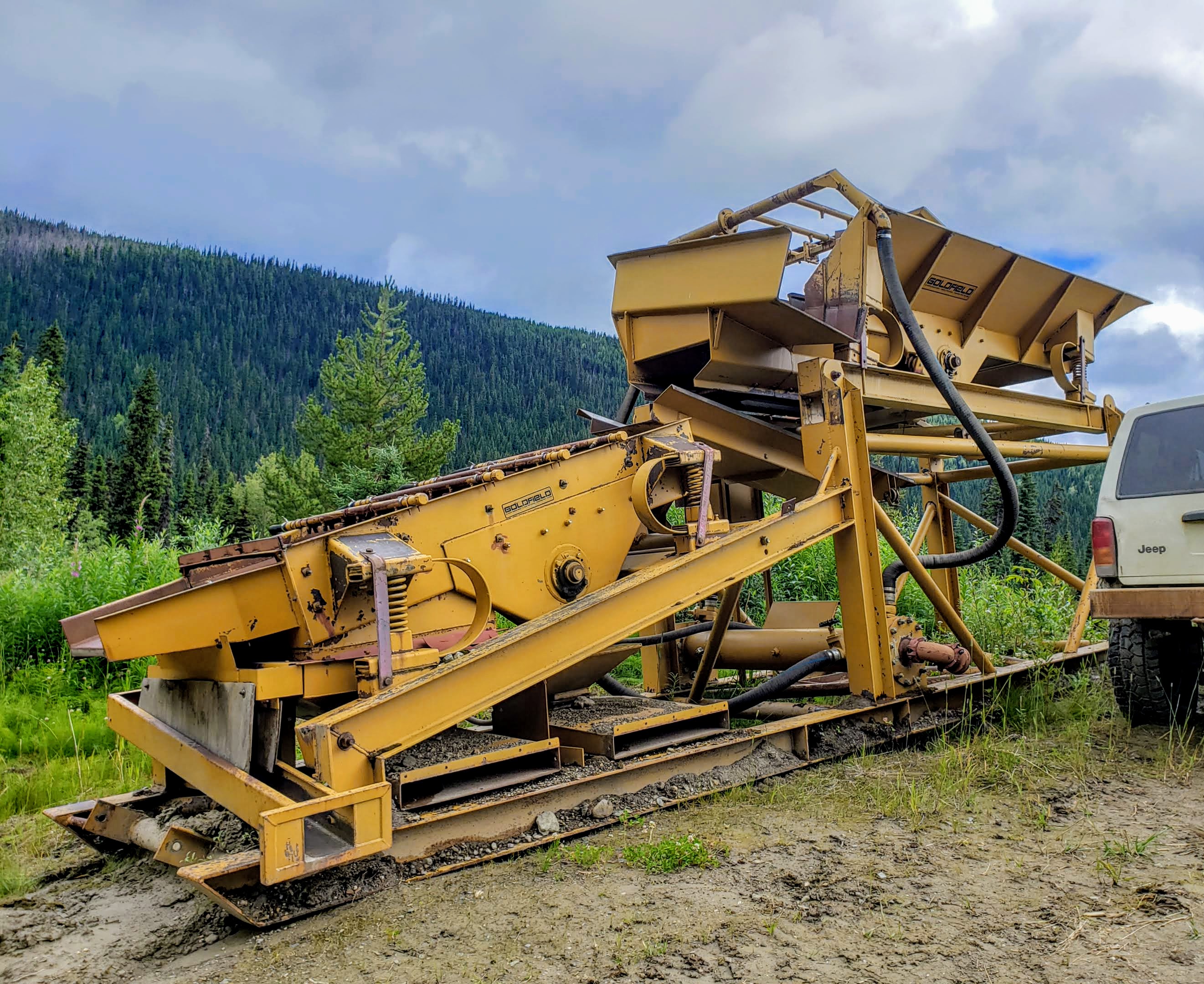
Screen decks use a series of vibrating screens and water jets to wash gravel and separate large rocks. Each deck is mounted on an angle and suspended by springs and caused to vibrate by mechanical means. There can be multiple decks used or just one.
Like a trommel, screen decks are fed at one end and allow oversize material to fall off the other end. There are perforations in between which allow material to fall through to the lower section. The vibration is caused by the rotation of an unbalanced weight called an “exciter”. That is actually the same thing that causes your cell phone or an Xbox controller to vibrate just on a much larger scale. The exciter is driven by a gas or electric motor. Some smaller models such as the Goldfield Prospector drive the exciter by a pelton wheel using water power alone and no motor.
A series of high-pressure water jets are used to wash material as it vibrates. Screen decks allow for well-positioned water jets to be put in place for thorough washing of gravels and rocks. There are a variety of screen options varying from woven wire, to punch plates and rubber or plastic perforated material. Screen sizes vary depending on the gold distribution and material being processed, customization of screen sizes is easy to achieve.
Screen decks can accomplish very high production in the right materials. Some of the largest wash plants in the world are using screen decks for that reason. Unlike a trommel, screen decks do not handle clay or compacted material very well. It tends to bounce off the screens and roll off the end. Despite the violent nature of vibrating beds the screen deck is a relatively simple machine and does not require a lot of maintenance. The only part that is mechanically driven is the exciter and there aren’t a lot of moving parts compared to a trommel or a derocker.
Screen decks tend to be quite high off the ground (at least large scale wash plants). They generally require enough of an elevation difference at the site to be able to feed the hopper and allow room for a concentrator below. Some miners use a conveyor system to get around this problem but mobility is not the screen deck’s strong suit. They work best in a stationary position where they will be used for a long period of time.
Pros
Cons
High volume
Struggles with clay and compacted material
Mechanically simple
Large footprint
Fuel-efficient
Difficult to move
Separation of multiple sizes
Slow to set up
Reverse Trommels
There are a few variations of reverse trommels that work a little differently than a basic trommel. A reverse trommel allows heavy material (ie. gold) to exit one end while the large rocks and waste material exit the other. Reverse trommels often have a double tube design with an inner trommel that screens the material while the outer trommel has a screw-like helix that separates the gold.
The trommel is set at the appropriate angle to allow gold to exit one end while water flows over the outer tube. The helix acts in a similar way to a gold wheel, the material of higher density is allowed to work it’s way up the spiral and exit on one end, the less dense material falls out the other.
There are some models with only one opening that kind of resembles a cement mixer. The APT RG-30 for example. They work in a similar way with a helix and a carefully positioned angle and rate of water flow.
Reverse trommels are popular in the mid-sized range from 1 to 10 yard per hour units. There are quite a few on the market. One popular unit is the Mountain Goat Trommel which is a hobby-level clean-up machine. There are large-scale commercial versions and everything in between.
Reverse trommels are interesting machines and work well once they’re set up but they are much more complicated machines than a basic trommel and are finicky to set up. They also require a lot of maintenance. That’s one reason they are mostly on the small-scale side of the industry.
Pros
Cons
Can produce very clean concentrate
Require a lot of maintenance
Break up clay very well
Slow setup
Separation of multiple sizes
Complicated machinery, lots of moving parts
Some designs are very compact
Not very fuel-efficient
Derockers
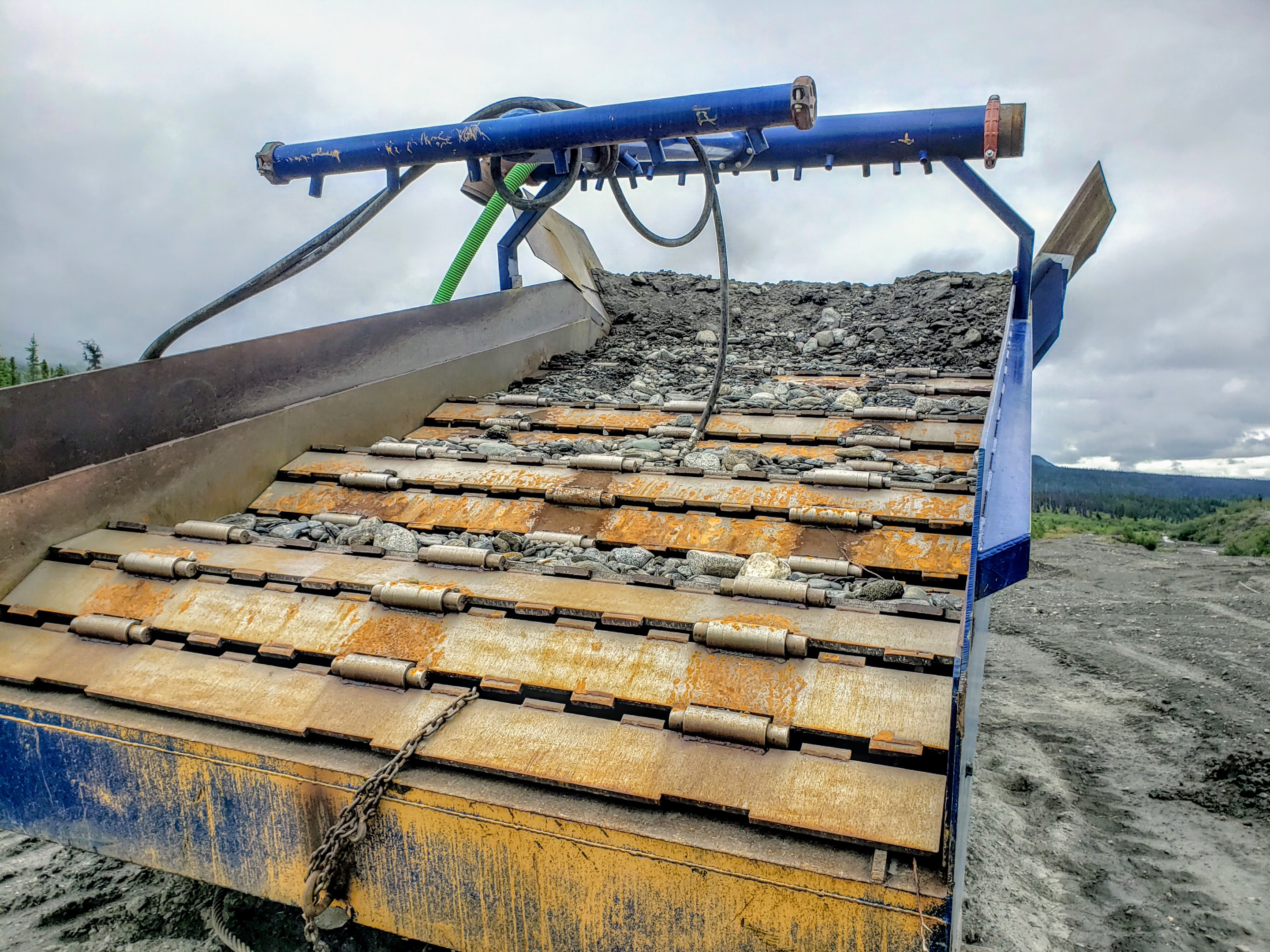
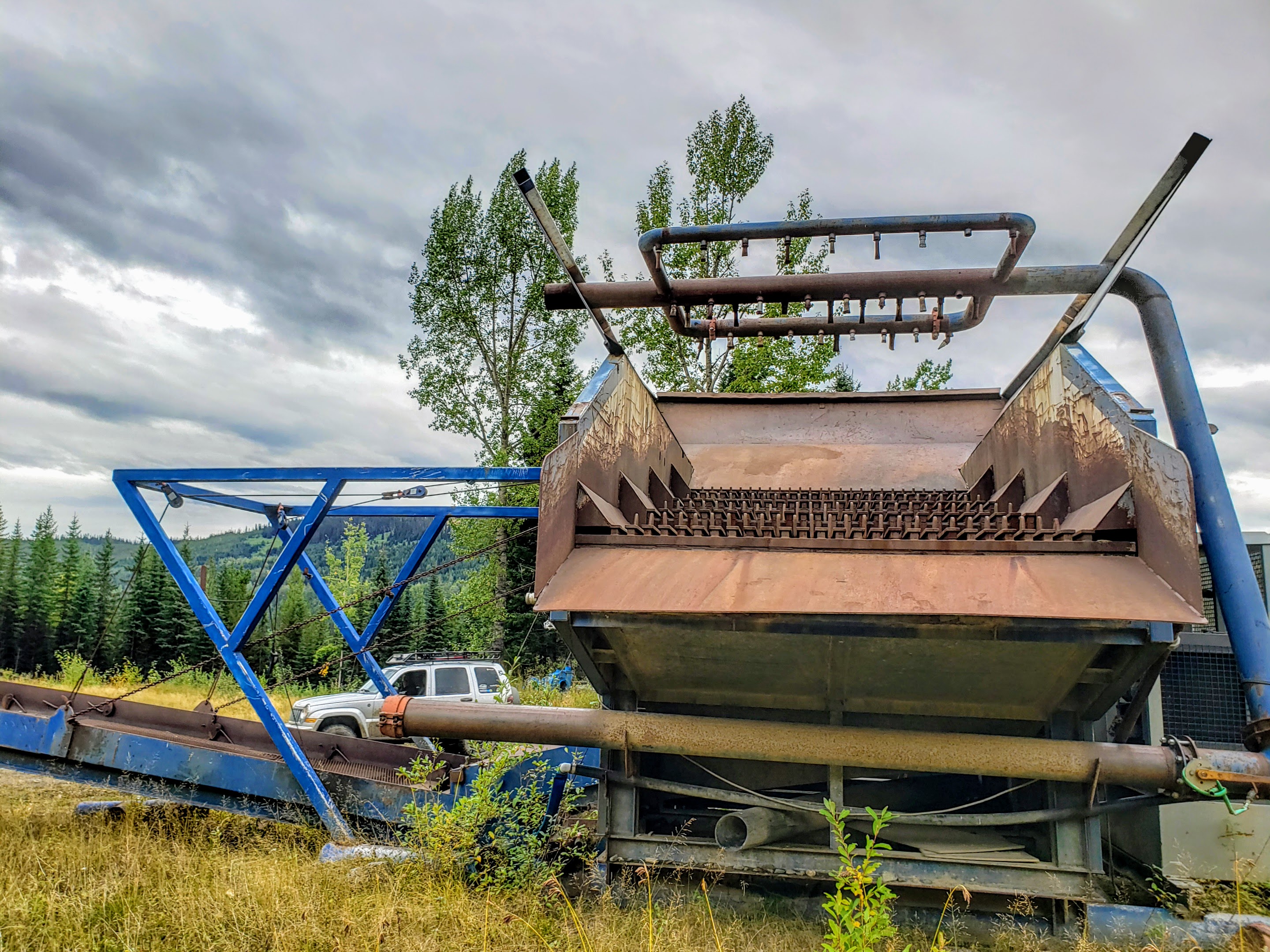
Derockers are a neat machine. They use a flexible deck made of long flat slabs with spaces between them. Under the deck is a carriage frame with truck tires that moves back and forth. There is a high-pressure spray system overhead that washes all the material. As the undercarriage moves back and forth it rolls the rocks around on the deck. The water and rolling action work together to wash off the rocks and allow smaller-sized pebbles and material to fall through the openings in the deck slats (usually 2” minus).
Derockers work really well in areas where there are a lot of large rocks and slabs. They are called “de-rockers” after all. They can handle some clay, due to the rolling action they can break it up somewhat. The derocker was invented in the Yukon to deal with gravel deposits that are full of boulders. These machines can easily handle boulders or slabs up to 4 feet in diameter, which would break other types of separation equipment.
Compared to some of the other scrubbers such as screen decks and trommels, the derocker is a complex machine with a lot of moving parts. You have a carriage that takes a beating, the deck has a lot of links to maintain but the derocker frame itself is stationary.
Super Sluice Derocker in Cariboo, BC
There was a variation of the derocker in the 1980s called the Super Sluice, made by a company called Gold Machines Inc, that used metal fingers instead of the flexible deck. The Super Sluice was very popular for about 10 years in the Cariboo, Klondike and Atlin but over time the complexity of the machine led to frequent breakdowns and they are very few still in use today.
Pros
Cons
Handles large boulders and slabs
Require a lot of maintenance
Can break up clay and compacted material
Complicated machinery, lots of moving parts
Very high production with the right material
Require a lot of water and power to run
Quick setup, easy to feed
No adjustment for screening options
Grizzly
Some wash plants don’t have a mechanical separation system at all, some use a simple grizzly. A grizzly consists of vertical bars with spacing to allow the size of material you want to pass through. The grizzly is set on an angle such that the larger rocks will roll off and the stuff that fits through the bars will pass through.
Highbankers and small test plants use a grizzly. Production is slow and they often require manual intervention to clear the large material that collects below. Grizzlys are often incorporated into other separation equipment such as screen decks and trommels.
Pros
Cons
No moving parts, no breakdowns
Slow production
No motors needed
No ability to clear tailings
Easy to move, no setup required
Screened material is still coarse
Easy to change for different size of gravel
Concentrators
The concentrator is the heart of a washplant. It’s the part of the wash plant that catches the gold and other dense material.
Placer concentrators all use gravity and inertia to separate material based on density. Gold is very dense, it has a density of 19,300 kg/m³. That means that one cubic meter of gold would weigh 19,300 kilograms (19.3 metric tons). In contrast, the typical gangue minerals such as quartz sand have a density of 2,700 kg/m³ and the black sands have a density of about 5,200 kg/m³.
All concentrating methods depend on this principle, except for the use of mercury but that’s not used in large-scale placer mining.
The Sluice Box
In North America, the sluice is the most common concentrator on commercial placer gold wash plants. The sluice box was developed during the California gold rush around in 1849. The first sluices were called Long Toms. Early sluice boxes consisted of long wooden boxes with wooden riffles and moss or burlap to line the bottom. The primitive long toms saved a ton of labour but miners at that time did not have a pre-scrubber and had to pick all the rocks out by hand and pan all the concentrates.
Modern sluices haven’t changed that much from the original design. We use metal now and have scientific studies to analyze the optimal riffle designs and matting but the concept is exactly the same.
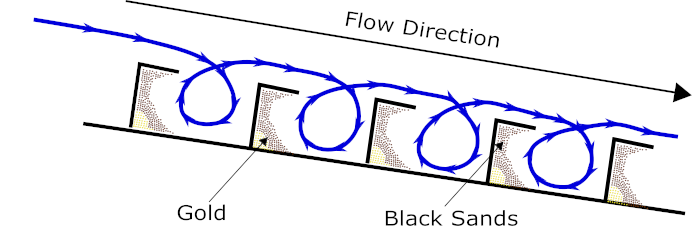
Sluices work by creating a vortex behind the riffles. As the gravel/water slurry flows over the riffle it creates an eddy current as it rolls back on the riffle. The eddy causes the water to momentarily lose inertia and it can no longer carry the dense sediment. Dense material is held in the riffle as long as the water is flowing. Once the water stops, the suspended material is released from the riffles, that’s why it’s not good to stop and start a sluice box.
There are a variety of riffles in use today but they all work the same way. There have been some excellent studies on different riffle designs and matting.
A study of the fine gold recovery of selected sluice box configurations, Jamie Hamilton at UBC: download PDF
Placer Gold Recovery Research by Rany Clarkson of New Era Engineering: download PDF
Studies show which riffle designs work the best, what spacing between riffles is optimal and what angle to run at, typically 1.5 to 2.5 inches/foot of sluice run.
There are several different types of riffles in use today. The Hungarian riffle and expanded metal are most common in commercial sluicing operations. Miners in New Zealand developed the hydraulic riffle in the 90’s that allows water to inject under the riffle which keeps them from packing. It’s similar to the way that the Knelson concentrator uses a fluidized bed, more on that later in this article.
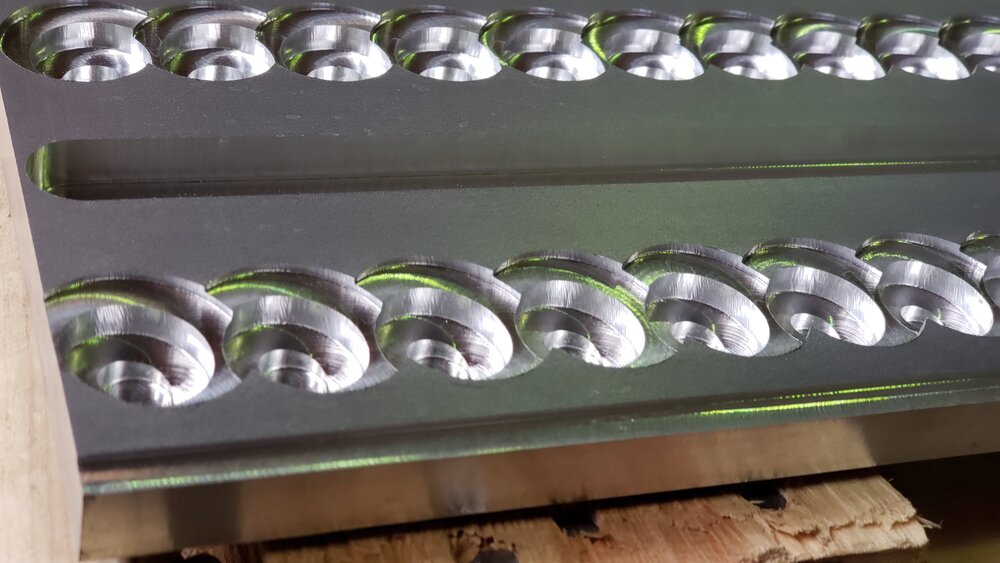
Some modern designs have abandoned riffles altogether and use a drop riffle or vortex such as the Devin Sluice or Dream Mat. These vortex systems catch gold in spirals carved into the matting or machined into aluminum sheets. Vortex riffles and matting have the advantage of quick clean-ups but they tend to work better on small-scale operations and clean-up sluices.
Devin Vortex Riffles
Different types of matting are used to catch fine gold. Miner’s moss is a typical matting that is made of a synthetic material with lots of loops to catch gold. Miner’s moss is kind of like a thick version of the soft side of velcro or thick carpet. Actual carpet is used in some cases as well. There are lots of high tech rubber designs on the market such as Gold Cube matting, Gold Hog, Dream Mat and many other designs. Some matting is easier to clean up than others but they all catch gold.
Other variations on the sluice include the live bottom and oscillating sluices. The live bottom box works really well. The live bottom box uses a thick rubber sheet on the bottom of the sluice box and has mechanized rollers that sort of massage the rubber moving it up and down. Similar to the rollers in a massage chair. That keeps the material from packing up and keeps the gold at the bottom.
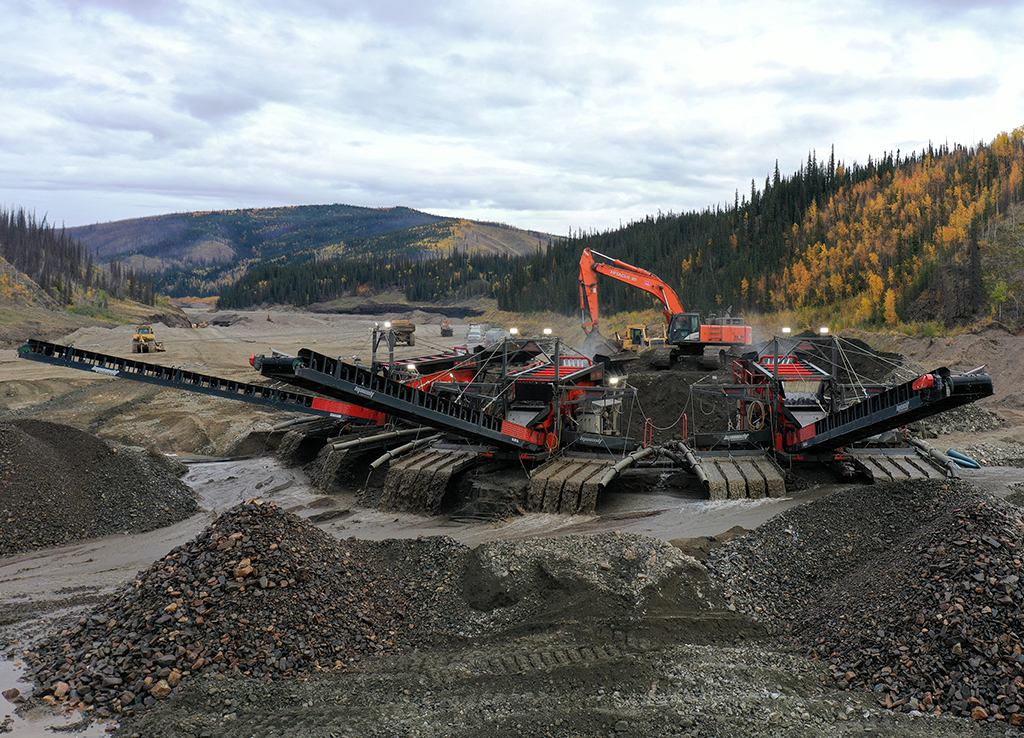
Sluice boxes can handle huge scale production, they can be made very large and multiple sluices can be run together to handle even higher production. The largest wash plants in the world run multiple sluices. All sluices require careful setup and lots of tweaking to make sure they’re catching all the gold. Sluice riffles will eventually become packed with black sand and can no longer catch gold, for this reason, a sluice must be cleaned out regularly.
Despite the ubiquity of sluices and their simplicity an alarming number of commercial miners are losing fine gold off the end of their sluice. Quality control and testing is essential to make sure that your sluice is operating as it should be. A full-scale sluice can reliably capture gold down to 150 mesh with proper setup.
Sluices have the major disadvantage of slow cleanup times that require a full shutdown. They also lose gold when you start and stop the slurry feed. They are simple and easy to repair in the field though.
Pros
Cons
Can handle large volume
Proper setup is critical
Simple design, easy to fix in the field
Require shut down for cleanup
Modifications and adjustments are easy
Large footprint on commercial operations
Require frequent cleanups
Hydrostatic Jigs
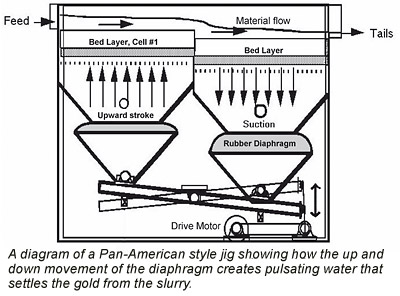
Hydrostatic Jigs, often just called “jigs” are very different than a sluice. They use a pulsating water action to separate gold from the lighter gangue materials. Jigs have serval components that work together to separate gold. Typically they have a screen in the upper section which holds a layer of steel balls called “ragging”, usually about 3” thick. Below the screen and ragging is a rubber diaphragm that is moved up and down rapidly by mechanical means producing a vertical pulsing action. The feed material flows over the screen is allowed to settle into the ragging.
The pulsing action in combination with the steel shot allows dense materials to settle to the bottom while lighter material is forced up and carried away by the flow. The action of the jig is based on Stokes Law which determines the rate at which particles fall while suspended in a fluid based on their density. Jigs are usually arranged in a series of cells, each with its own screen and diaphragm. Any number of cells can be used in combination to increase capacity.
The gold is stored in a container in the bottom called a “hutch”. One advantage to this system in commercial operations is that gold nuggets and pickers are not sitting in the open as they would be in a sluice box so it would be difficult for an employee to steal the gold.
Jigs first came into use in placer mining in 1914 in California. They were soon adopted to the large floating dredges that were in use at the time. Jigs had several advantages over sluice boxes. First, they take up much less space, which was important on a floating dredge. Secondly, they can be cleaned out without having to shut down the operation. You simply need to drain out the hutch and you’re back in business.
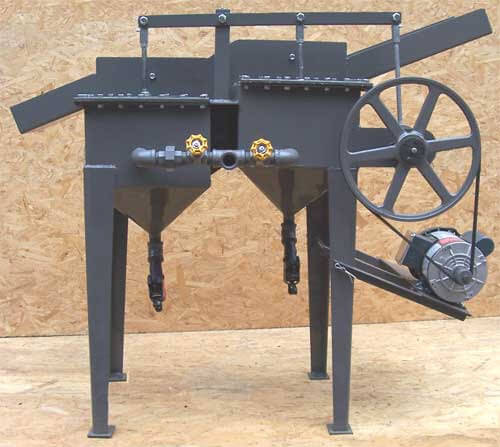
One of the first jigs used in placer mining was the Pan American Jig wich consisted of two cells. The Pan American model had two 42-inch square cells and could process 20 yards per hour. Multiple units were used in tandem to increase capacity.
Many modern jigs follow the exact same design as the Pan American. Many manufacturers around the world still produce an almost identical machine. There are many variations of jigs today but they allow work on the same principle. Smaller jigs are often used for cleaning concentrates but larger units are also used in full-scale commercial operations.
Pan American Jig
Pros
Cons
Clean up without shutting down
Initial setup requires lots of tweaking
Small Footprint
Rubber diaphragm wears out
Gold stored in safe container
Low capacity per cell
Dummy proof once set up
Specialised parts required
Centrifugal Concentrator
Centrifugal concentrators are the most efficient method for concentrating placer gold in terms of capturing fine gold and overall revocery. They rely on a rotating drum that resembles a washing machine. The drum spins at high RPM, usually at least 100 RPM, creating a centrifugal force that pushes heavy elements to the outer edge. If you’ve ever ridden the gravitron ride at an amusement park you’ll know firsthand how this works.
In a centrifugal concentrator, the lighter material is allowed to flow over the top of the bowl and is discharged as tailings, the dense material is held in riffles and retrieved during cleanup. The principle is similar to a hydrostatic jig except more G forces are applied. At high G forces centrifuges are less sensitive to particle size than other gravity methods (sluice, jig, etc) and as such can retrieve extremely small gold grains down to 400 mesh.
There are four types of centrifugal processors on the market today: the Knudsen Concentrator, Falcon Concentrator, Knelson Concentrator, and the Gold Kacha.
The Knudsen was the first centrifugal concentrator used in placer mining. It was invented by George Knudsen of California and patented in 1942. The Ainlay bowl was patented in 1928 and saw some experiments in placer mining but didn’t take off. The Knudsen bowl is a 12” to 36” diameter bowl mounted on a vertical drive shaft. The bowl is tapered to allow the slurry to rise up the side while the riffles catch the gold. The Knudsen bowl was used all over the world most notably in California, New Zealand and in Africa. The Neffco Bowl is a modern version and is still used today.
The Knelson Concentrator was developed in Burnaby, BC in 1980. The Knelson is a bit more complex than the Knudsen Bowl and runs at a higher RPM. The Knelson concentrator uses a perforated cone and uses pressurized water that forces in from the outside of the bowl. The cone experiences a force of 60G’s while the water pushes against it, the counteracting force acts to keep the heavy particles fluidized allowing a continual replacement of light grains by heavy ones and avoiding the compaction of riffles like you see in a sluice. The Knelson concentrator is very efficient but like all centrifugal concentrators it requires frequent cleanups.
Falcon concentrators are similar to the Knelson. The main difference is the angle of the walls. Both use the same water pressure system that pushes against the centrifugal force creating a fluidized bed. Falcon (now called Sepro Mineral Processing) is based in Langley, BC, and was founded in 1987. It’s interesting that both Knelson and Falcon were developed in Greater Vancouver. Both companies are world leaders in mineral processing technology.
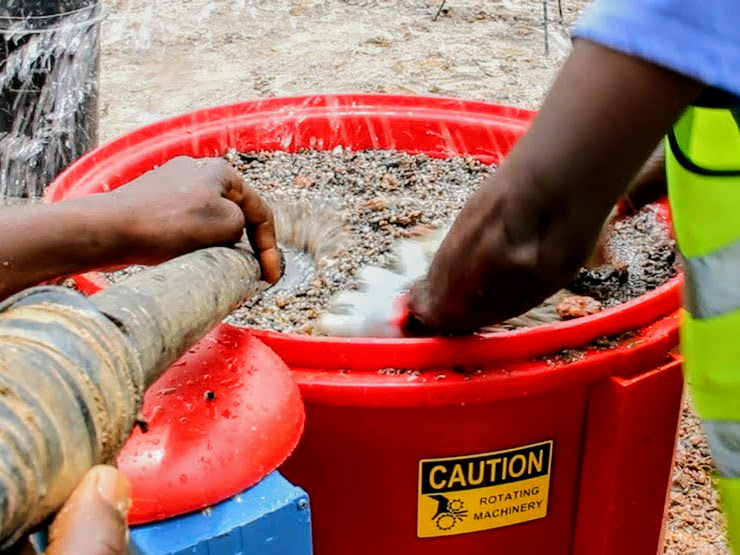
The Gold Kacha (GK) is a really cool system. I was introduced to this device on a recent placer exploration trip to Sierra Leone, Africa. The Gold Kacha was developed in 2005 in South Africa by Appropriate Process Technologies (APT). It’s similar to the Knudson/Neffco bowl but has several advantages. The Gold Kacha can easily process gold down to 450 mesh (30 microns) and the riffles are designed to prevent gold compaction. The GK can run 3-4 cubic yards per hour.
It’s set up in a turnkey package that’s easy to use. The biggest advantage is that the Gold Kacha retails for $1,500 USD. All the other concentrators on this list are at least 4 times that cost but the GK was designed for use in third world Africa to help artisanal miners avoid using mercury.
All centrifugal gold processing machines work well for catching very fine gold, they catch coarse gold too but the fine gold is the challenging part. Centrifugal processors can catch extremely fine gold very well but they require frequent cleanups, usually every hour or so. Some wash plants use multiple centrifuges and are able to isolate them using valves so that while one centrifuge is being cleaned the others are still operational, I think we’ll see more of these systems in years to come.
Pros
Cons
Able to retrieve gold < 400 mesh
Frequent cleanups are required
Easy to use, no special knowledge required
Very expensive (except Gold Kacha)
Low water consumption
Low capacity per unit (compared to sluice)
Low power/fuel consumption
Requires thorough pre-screening and clean water
Spiral Concentrators
Spiral concentrators are not commonly seen at placer mines these days. They were popular in the 70s and 80s but have fallen out of fashion. They are very commonly used in the beneficiation of heavy mineral sands, chromite, tantalite, iron ores and fine coal.
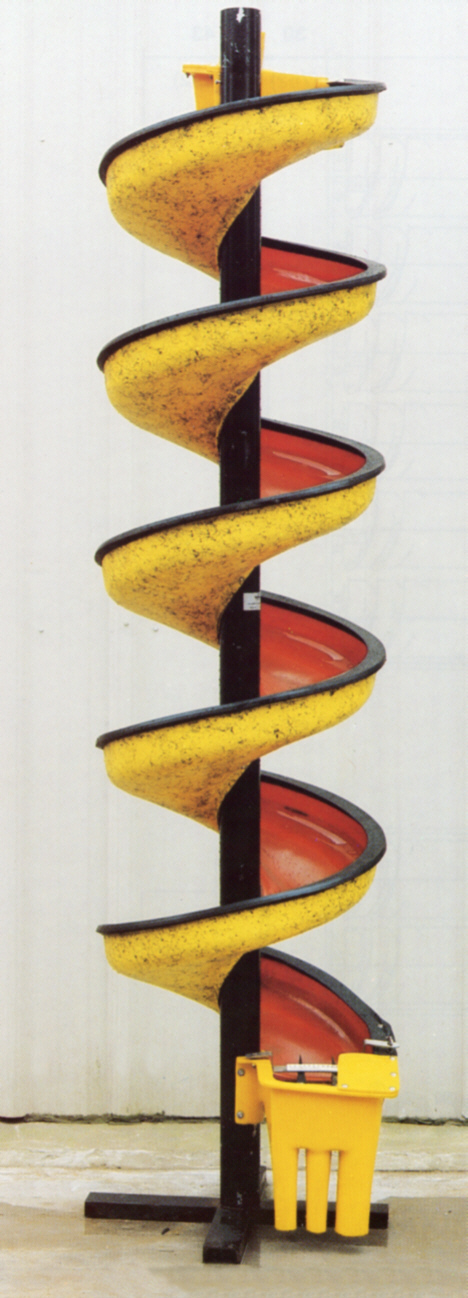
Basically, spiral concentration involves a stack of spirals that are fed from the top using a low-pressure slurry pump. The slurry flows down the spirals like a water slide and separates based on density. At the bottom there are splitters that divert the slurry at different points along the radius of the spiral. The outside of the spiral will have the tailings, since they are less dense the spiral action forces them to the outside, the concentrated gold is on the inner radius and the “middlings” are in the middle. The principle is similar to the way that a shaker or wave table separates gold.
Spirals are often run several times so that the middlings can be run again to increase their level of concentration. There are several variations such as the pinched sluice and the Reichert Cone which uses a series of stacked cones instead of spirals. The spirals are usually made of fiberglass and are lightweight and fairly inexpensive. They are able to reliable capture gold from 6 to 200 mesh, some models can catch down to 300 mesh. Placer spiral systems can handle 4-10 yards per hour but can be scaled up with more units.
Pros
Cons
Able to retrieve gold < 300 mesh
Require consistent, laminar flow
Easy to use, no special knowledge required
Low capacity per unit (compared to sluice)
Low cost and cheap to operate
Requires thorough pre-screening
Low power/fuel consumption
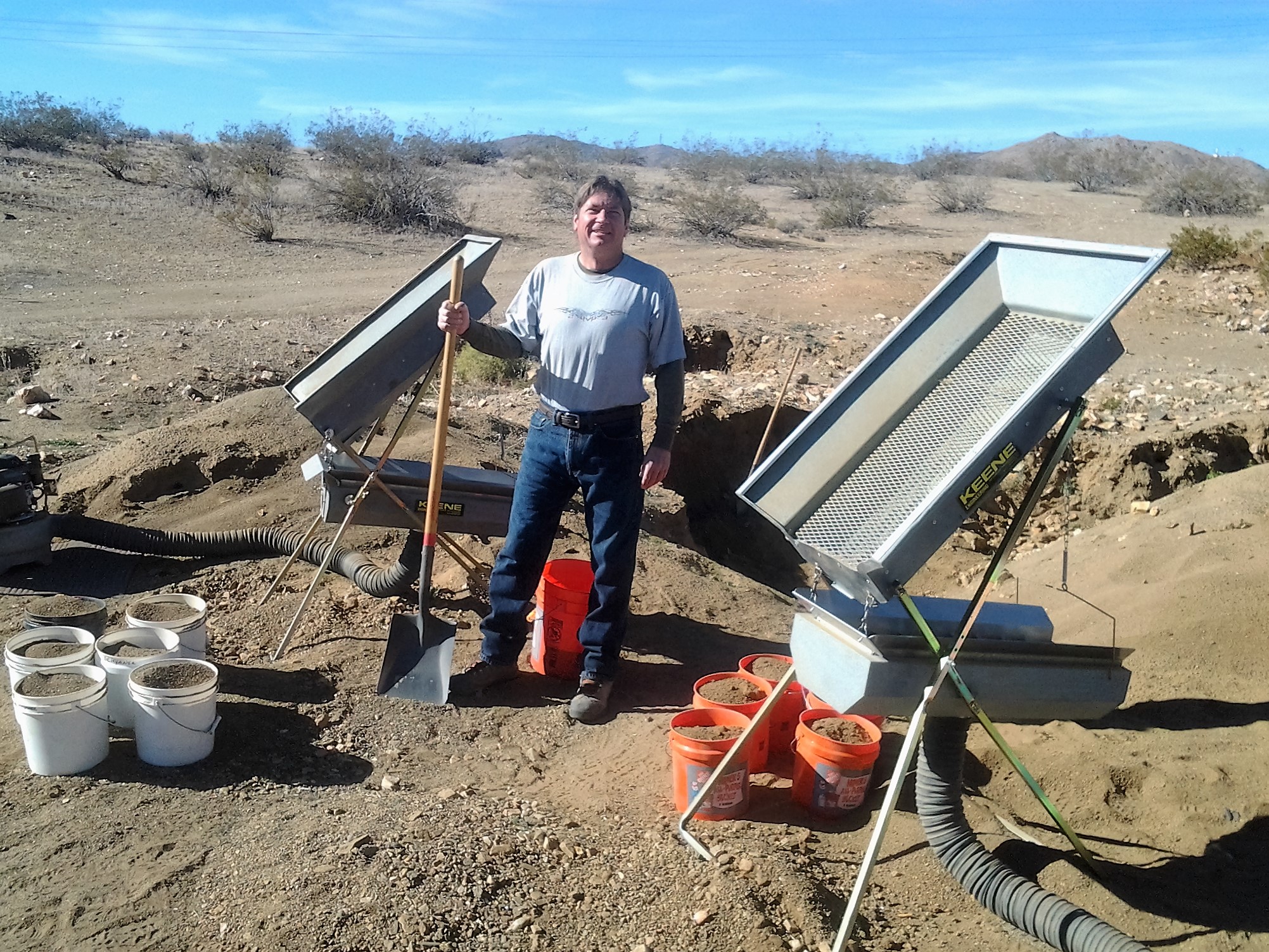
Dry Washers
Gold is found in areas that don’t have water available, such as the desert regions of California, Nevada, Arizona, and Australia. Placer miners came up with a solution for dry washing.
The process works on the principle of winnowing, which uses wind or air to separate dense material from less dense material. The technique has been used for millennia to separate grains from their husks. Dry washers use a short, waterless sluice and pressurized air in combination with vibration. The sluice portion of a dryswasher has a porous bottom, either canvas or a very fine screen, that allows air to pass through. The whole thing is set on a steep angle so that the material can work its way over the riffles. Air blows up from the bottom and provides some buoyancy for lighter material.
Small scale dry washers resemble a highbanker with a screen/grizzly on the upper section and a sluice-like screen setup on the bottom. There are hand-operated units using bellows, and gas-powered blowers. Commercial-scale drywasers are somewhat rare but they are used in gold-rich areas of Australia and parts of the United States.
There are no manufacturers that make commercial-scale dry washers. All large scale units are custom made. Most of them are fed by a loader and distribute the material through a screen system into multiple cells of smaller dry washer sluices. Keene is developing a commercial drywasher but it’s not available at this time.
Material to be run in a drywasher must be completely dry, it must contain less than 3% water otherwise it won’t work. The material must also be disintegrated and not clumped together by clay or caliche. Studies show that under ideal conditions a dry washer will have about 15% less recovery than a wet system (ie. sluice).
Pros
Cons
Doesn’t require water
Lower recovery than wet systems
Can be moved rapidly
Makes a lot of dust
Fast cleanup (compared to wet sluice)
Frequent cleanups are required
Feed Systems
We’ve covered screening systems and concentrators. The next component of a wash plant is the feed system. Wash plants can be fed in different ways. Some have a hopper that is fed by an excavator or loader, others are fed by a slurry pump or dredge.
Hoppers
The most common feed system on a wash plant is the hopper. The hopper is a large container that is filled with raw gravel and allows it to be dispersed at an even rate. Many hoppers are gravity-fed, they operate in a similar way to an hourglass. They have an inverted pyramid shape and act as a funnel.
Other hoppers have a belt or track in the bottom that manages the feed rate. I’ve seen some cool designs in the Yukon that use a recycled excavator track in the bottom of the hopper to slowly feed a trommel.
The hopper won’t feed itself and must be refilled regularly by an operator. Most operations either use an excavator or a front end loader to keep the hopper full. Some miners use a conveyor belt system in combination with a hopper to maintain an even flow of material.
Pros
Cons
Maintain even flow (when not clogged)
Large rocks can get stuck
Simple design, not much to break down
Requires operator to refill regularly
Bucket Ladder
The bucket ladder is the most efficient system for feeding wash plant. This was the norm on the monster floating dredges that scoured the gold-bearing placers of western North America from the late 1800s till the 1950s. These monster dredges moved ridiculous amounts of gravel, each dredge could efficiently process up to nine tons of gravel per minute, with an average of 20,000 cubic yards per day!
The bucket ladder consists of a boom and a series of metal digging buckets. It’s sort of like a giant chainsaw. The buckets are specially designed with a digging edge and held together with a giant chain. The boom is raised up and down with a gantry winch system. The buckets continually dump material into the scrubber system (trommel, screen deck or any other system that we discussed above).
The depth of the bucket line is limited to the length of the boom. Typical industrial dredges could dig up to 60 feet deep. The buckets are able to dig up soft bedrock but if hard rock is encountered they cannot. The buckets can’t handle large boulders either. The dredge in the video below isn’t at a placer mine but it shows what a modern bucket ladder dredge can do.
Environmental restrictions have made it a lot more difficult to operate a floating plant with a bucket line but some are still in operation today in Europe, Africa, Russia, China, Asia, South America, Mexico and the Yukon. Modern bucket ladder dredges are common in non-placer applications
Pros
Cons
Constant supply of material
Can’t dig too deep
Huge capacity
Massive overhead cost
Excavation and delivery in one step
Not very mobile
Few breakdowns
Regulatory hurdles
Gravel Pump
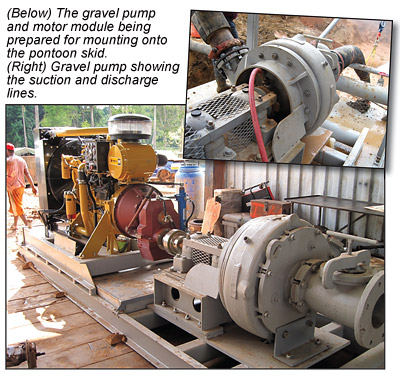
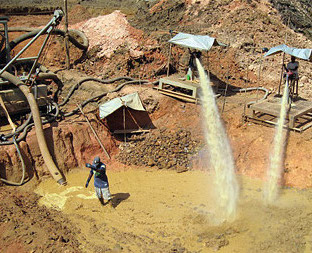
One of the most efficient ways to feed a wash plant is with a gavel or slurry pump. There are several large-scale placer mines in Alaska and other parts of the world that mine by hydraulic means using large water monitors. The material is washed into a pit and pumped up to the wash plant using large industrial slurry pumps.
Gravel pumps don’t work in every scenario but if your location is favorable this is a very efficient way to mine. The slurry pump can be unmanned, saving labour costs and allowing workers to focus on other areas of the mine. These pumps are very expensive initially but the savings in operating costs will pay off over time.
There are a lot of mines operating in wet ground in BC and the Yukon and a slurry pump would be an excellent solution. Instead of fighting the groundwater you can use it to your advantage.
Pros
Cons
Consistent feed of material
High initial cost
High capacity
Requires careful mine planning
Savings on labour
Doesn’t work in every location
Good solution for wet ground
Possible regulatory hurdles
Suction Dredge
Suction dredges are similar to a slurry pump set up. A suction dredge uses a venturi to create a vacuum that sucks up gravel and water at the same time. Floating dredges are commonly used in small to mid-scale mining. Floating dredges are classified by the diameter of the suction hose which varies from 3 to 8 inches.
Modern suction dredges first became popular in the 1950s due to the availability of good, portable, centrifugal water pumps and modern diving equipment. Some jurisdictions such as British Columbia and parts of California have banned suction dredging but it is a very efficient method that is used around the world.
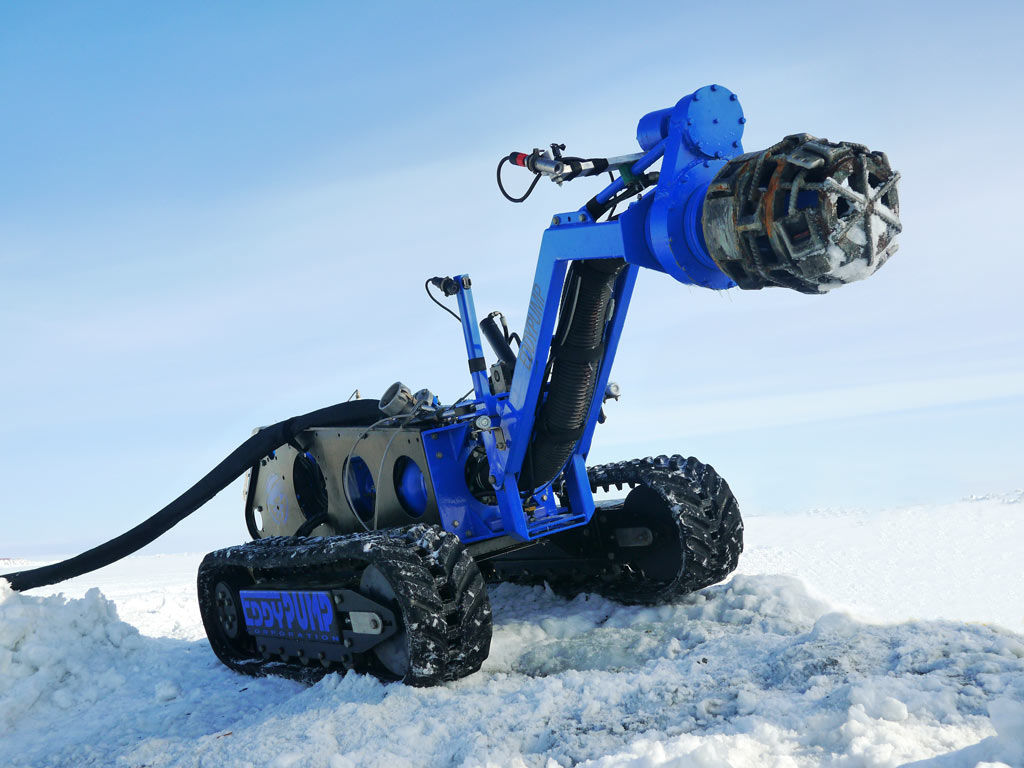
There are some very advanced dredge machines on the market today. Large scale operations are using 8-inch and larger suction lines. Some of the most interesting dredge innovations are being developed for use on the Bearing Sea in Alaska. The robot dredge in the picture below is a really cool new technology that uses a remotely operated robot with a cutting head attached to an 8-inch dredge.
Not all dredge systems use a floating platform and can be fitted to just about any wash plant. You can get excavator-mounted units up to 12” in diameter that can be used in a regular mining pit. These systems advertise up to 600 cubic yards per hour of production.
Some systems use slurry pumps instead of a venturi in combination with a cutting head. The advent of undersea mining has pushed the envelope on this technology and we’re going to see a lot of advancements in the coming years.
Pros
Cons
Consistent feed of material
Doesn’t work in every location
Excavation and feed at the same time
Possible regulatory hurdles
Can be unmanned
Wash Plant Carriers
This is the part of the washplant that supports the scrubber, concentrator, and feed system.
Stationary Skids
Many large wash plants are mounted on a steel frame welded to metal skids. This system isn’t very mobile. Skid-mounted plants are meant to stay in one place for a long time. When it’s time to move they are pulled by heavy equipment such as bulldozers or large excavators and dragged into position.
Skids are simple and stable but don’t provide a lot of mobility.
Trailer or Frame with Wheels
Small to mid-sized wash plants can be mounted on a trailer or frame with wheels. This provides an easy way to move it around. The trailer will often have a leveling apparatus to stabilize the plant while in use. Not much else to say, it’s a trailer we all know what that is.
Floater Plant
The floater plant, also known as a “Doodlebug” is a very efficient way to mine. The plant can be mounted on pontoons or a barge. Floater plants have the ability to move very rapidly in a pond of their own making. It takes planning to operate efficiently without boxing yourself in but when properly executed a floater setup can move a lot of material quickly.
Any type of scrubber, concentrator, and feed system can be fitted onto a floater.
The large bucket line dredges technically fall into this category but most floaters today use an excavator to dig and pull the barge. For a floater operation to work effectively the ground can’t be too deep. Floaters mine in one continuous direction mining in front of the plant while the tailings are deposited behind. It’s almost like an assembly line approach to placer mining.
Pros
Cons
Rapid movement
Don’t work in deep ground
Efficient mining and tailings management
Require a pond for the plant to float on
Floater Plant in Atlin, BC
A placer wash plant is the sum of its parts. It’s not a trommel, it’s not a sluice, it’s the whole package. There are just about as many combinations as there are miners. Placer miners are always coming up with new innovations to solve problems and mine more efficiently.
There is no one plant that is the best in every situation. They all have their strengths and their weaknesses. The type and size of your gold, the type of gravels you’re dealing with, ground conditions, regulatory environment, available capital, and other factors all work together to determine what type of wash plant is best for your mining operation.
In April 2021 West Coast Placer was hired to assist in exploration for a large-scale alluvial gold project in Sierra Leone, West Africa. This program took place in the Kono region of Sierra Leone which hosts diamonds as well as gold in their placer deposits. It was a great experience and it was really cool to see how they do things in West Africa compared to the West Coast of North America.
Sierra Leone is famous for its alluvial diamonds. We were working in the Kono district which is where the plot of the movie Blood Diamond took place. The region where Leonardo DiCaprio’s character died at the end (spoiler alert) is not far from the survey area that we were exploring.
Despite extensive diamond mining taking place in the region since the 1930s very little attention had been paid to the alluvial gold deposits. There are a lot of artisanal miners active in the area but their sole focus is diamonds and they often discard the gold that they dig up. That fact surprised me because even in Canada where the average income and standard of living is much, much higher nobody would ever throw gold back into a river. That’s one of many things that’s different in Africa.
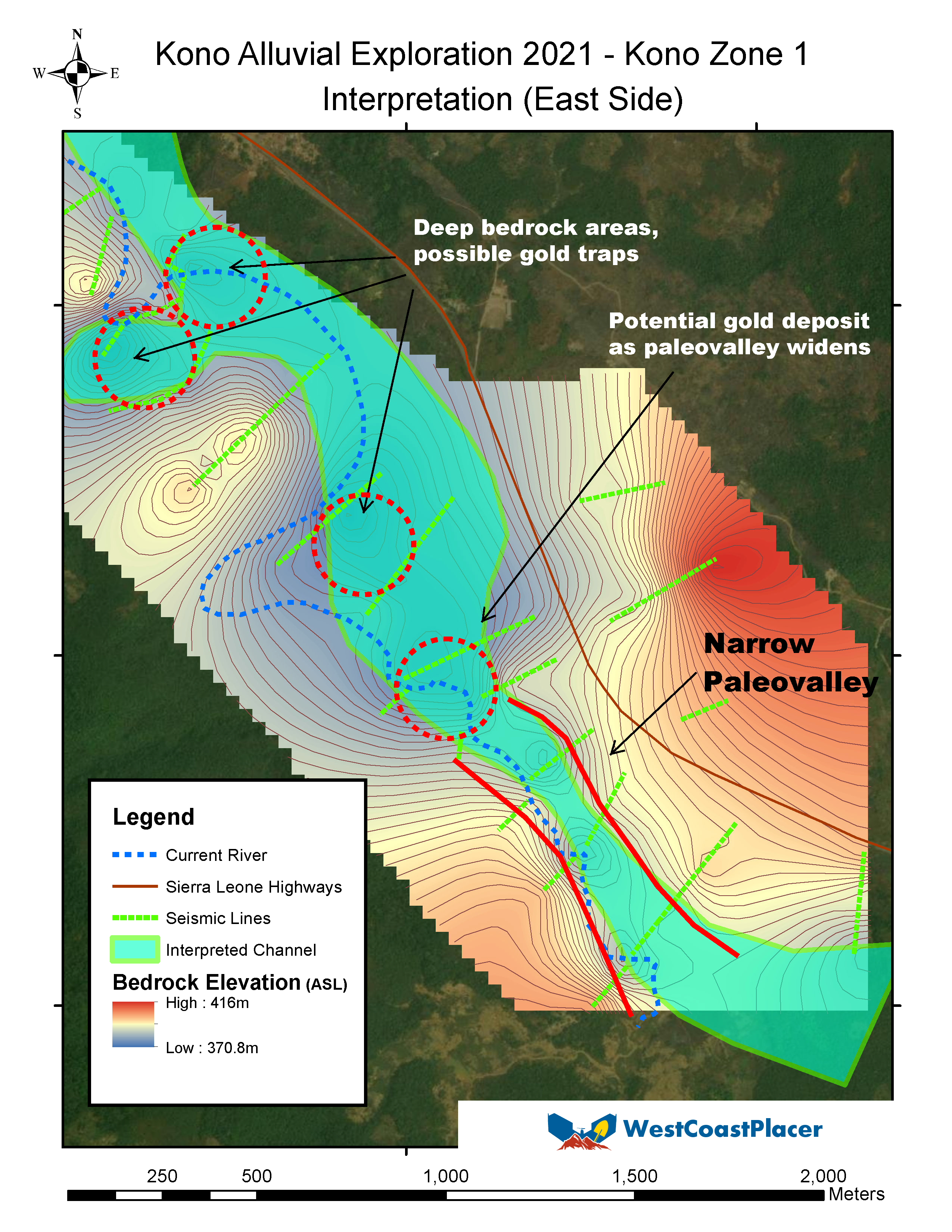
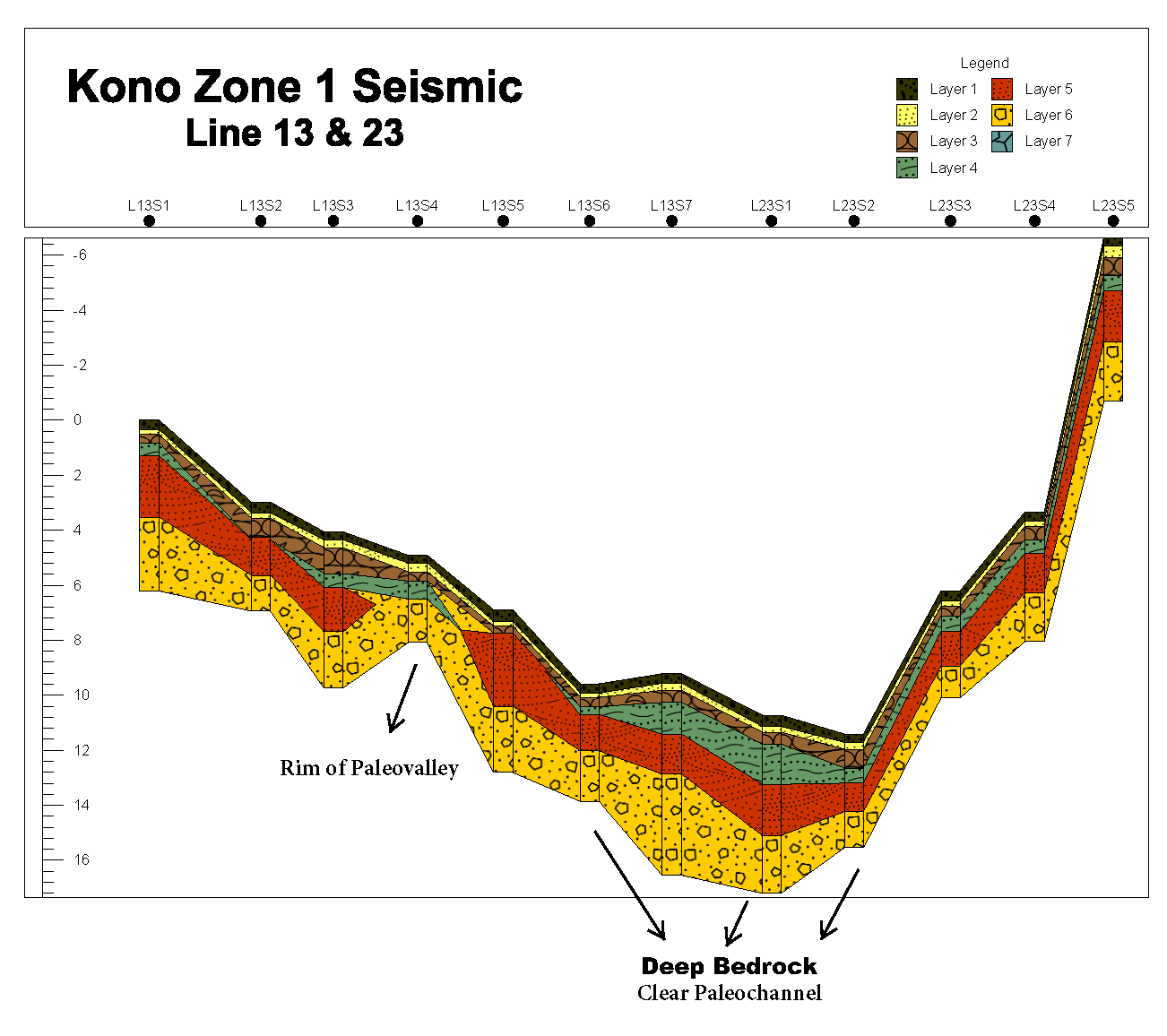
The placer deposits in the Kono region are much older than anything in BC or the Yukon. Much of the bedrock is Precambrian (500 million to 4 billion years old) and hasn’t ever been glaciated. By contrast, the rock in BC is less than 200 million years old and has been bulldozed by large glaciers on at least 4 occasions. Despite the differences, some things are the same in pretty much every placer environment. Over time rivers and streams move and leave their gold deposits behind in ancient paleochannels. That’s what we were looking for. Our system is designed to map bedrock depth and show the location of paleochannels.
Actual Map from a survey in Africa in 2021
Travelling internationally during the covid-19 pandemic is quite an adventure. In April 2021 the vaccines weren’t available yet and travel restrictions were very tough. We had to do lots of covid tests at each leg of the journey and there were a few hiccups. One of our team members wasn’t allowed to board the flight to Belgium from Montreal because his test was taken too far in advance. He had to get another PCR test and catch a flight the next day. On the way back I almost had to stay in a covid hotel, fortunately, the Canadian government honored my essential service exemption.
It was interesting that Sierra Leone didn’t have a lot of covid restrictions. That’s because three years prior to the breakout of Covid -19 around the world West Africa was center stage to the worst ebola outbreak in history. When covid broke out in 2020 they knew what to do and locked the whole country down with no exceptions. By the time we arrived in 2021 the whole country had a total case count of 80 and zero deaths. With the intense screening protocols for international travellers they were able to keep infection rates to a minimum, something that wealthy western countries weren’t able to do, even with the advent of vaccines.
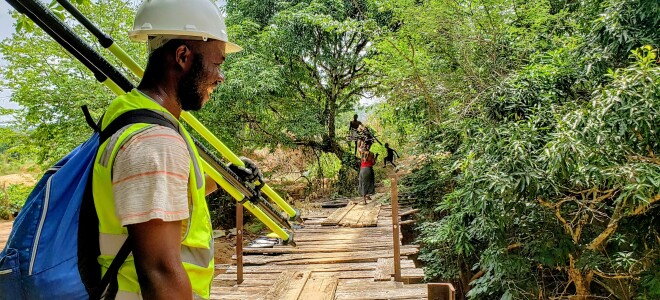
We spent a few nights in the capital city of Freetown and headed off to Koidu Town to begin our exploration. The bedrock mapping survey covered a large area that was chosen due to the prevalence of artisinal mining and topographic features that favoured the development of paleochannels. We had some knowledge of hard rock gold production in the area and anecdotal evidence from local artisanal placer miners.
There’s no 6 month wait for permits in Sierra Leone
We had a crew of local laborers which included the son of the Paramount Chief. That was important for public relations since we didn’t speak the local language and it was important to explain to the villagers what we were doing. Having the chief on our side let everyone know that we were working along with local government and not just rolling in to take all the resources for ourselves.
Sierra Leone is ruled by a combination of federal government and chiefdoms. The mining claims are managed by both levels of government in a complex way. Without the support of the chief it would be hard to get the necessary permitting and support of the local community. Luckily for us, the local chief is a miner himself and we got along really well.
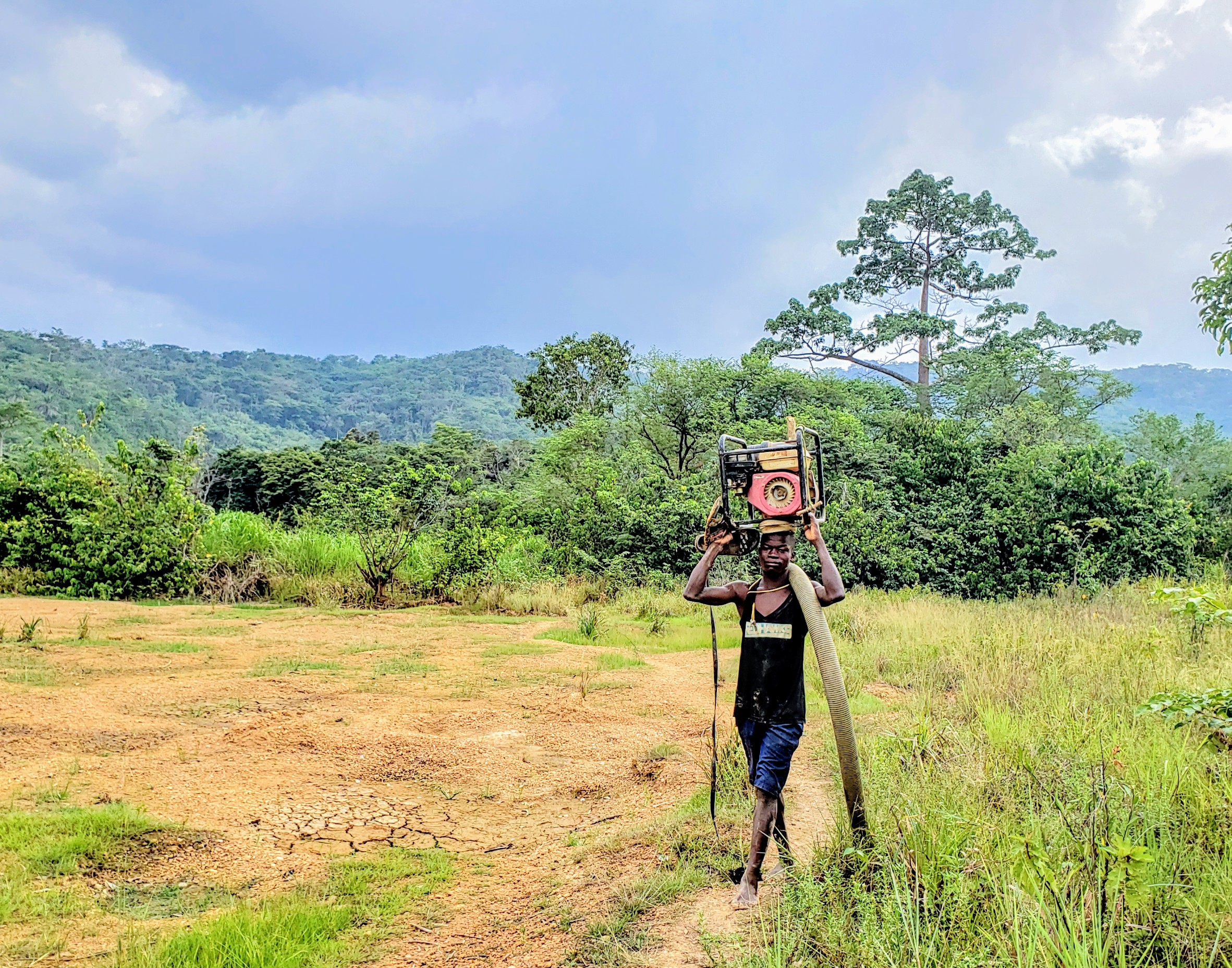
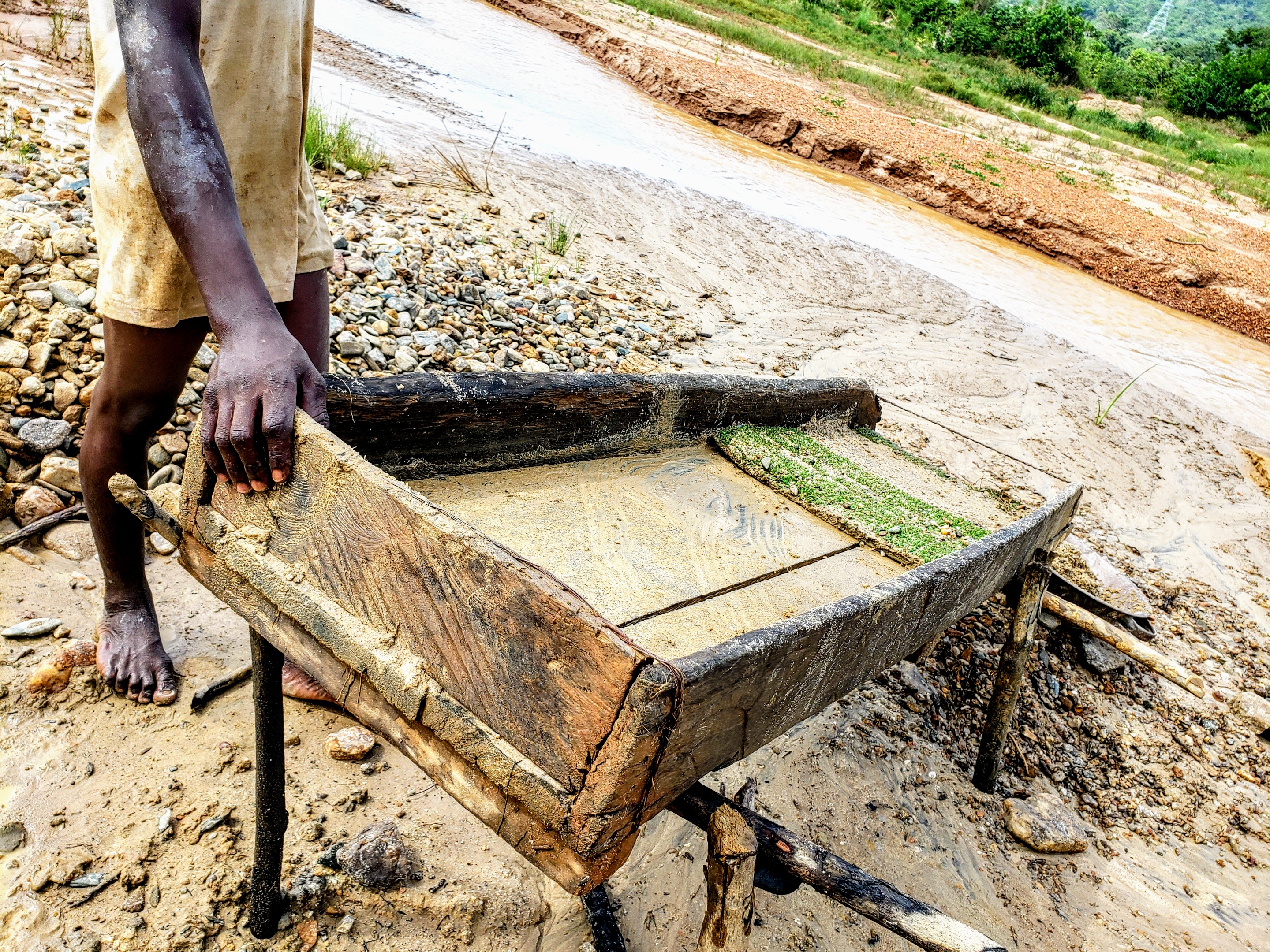
The artisanal miners do a lot of the work by hand. They often use gas-powered water pumps similar to what small-scale miners use in Canada. Mostly for dewatering though, they don’t have highbankers like we do back home. In Africa people carry everything on their heads, even the water pumps.
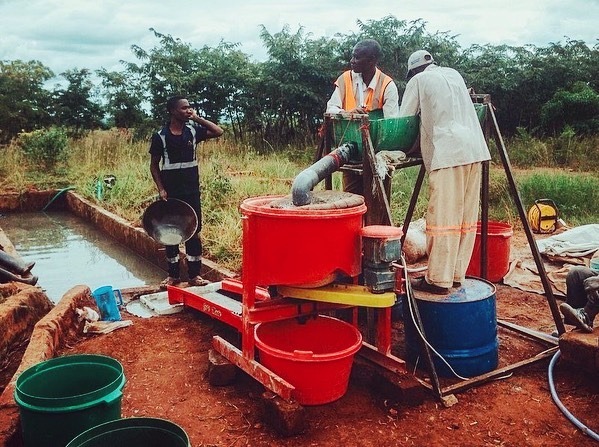
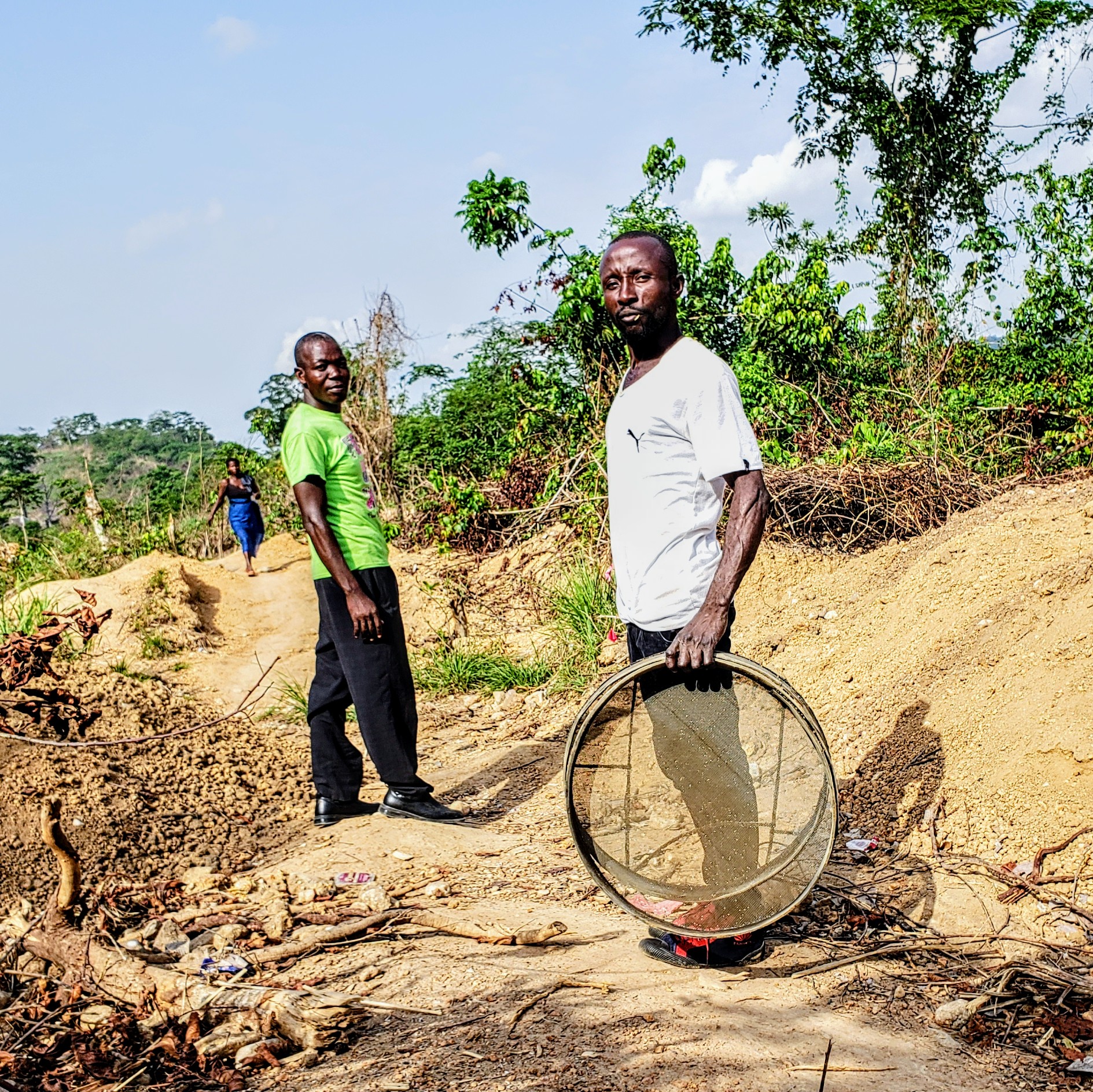
Most of the washing is done by hand using gem screens or large gold pans. The larger operations use a rudimentary hydrostatic jig. There are very few operations using heavy equipment but manpower is readily available in this area.
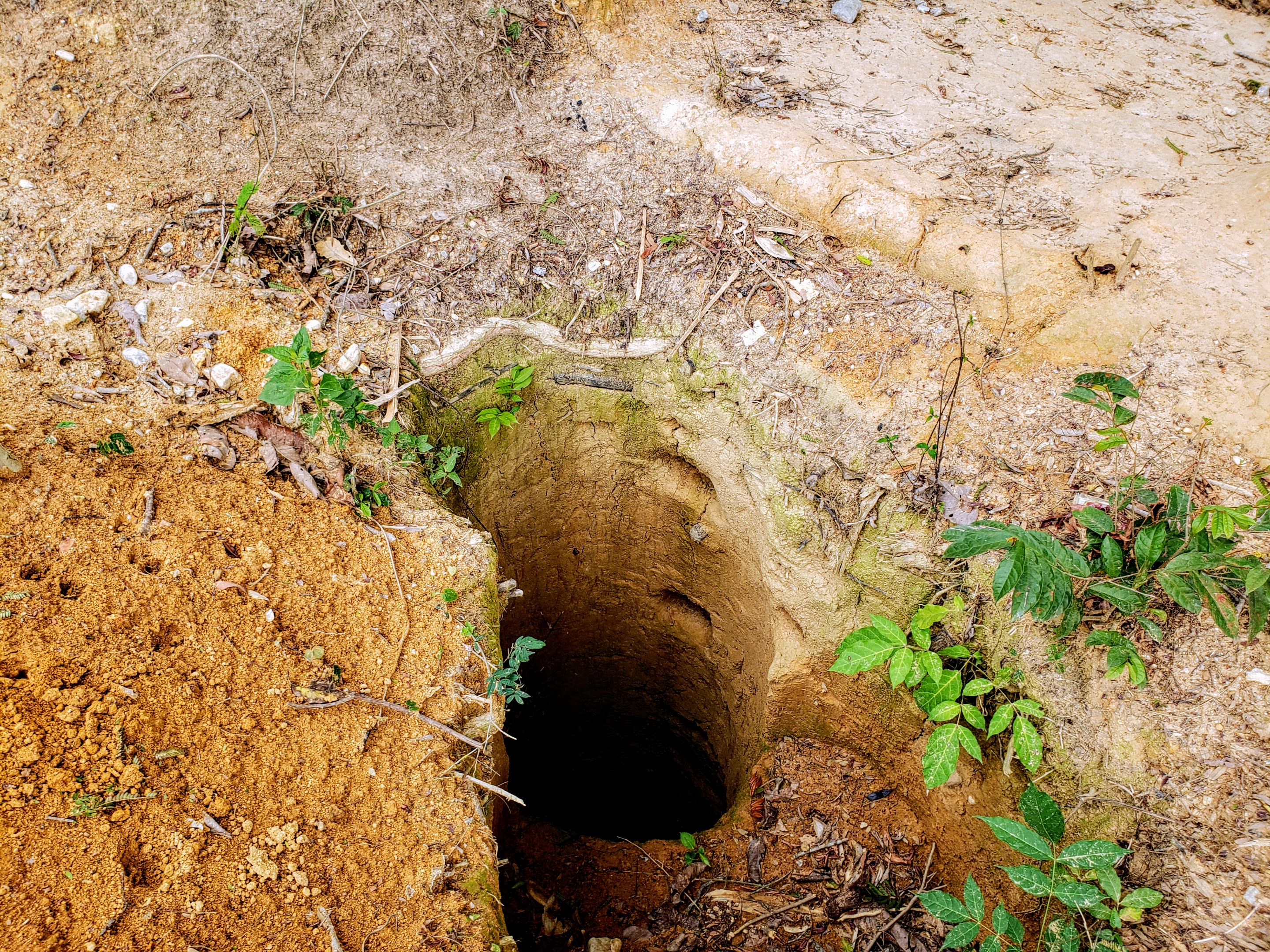
The local miners have a method of digging shafts that works really well in the clay-rich gravels in that area. They dig a shaft about 1 meter wide and dig out foot holds on the way down. In this way they can reach bedrock in a day or two and get really good samples from the bedrock interface. The company that we were working with hired a large crew of local miners to dig shafts instead of using a drill. The samples were better and expert shaft diggers were more than willing to work for $10 US per day.
Shaft made by artisanal miners in Kono region
Getting supplies in a third world country can be an adventure in itself. We tried to bring everything that we needed with us but we counted on procuring some supplies locally. One thing that we need lots of was flagging tape. Since this is a mining area we thought it wouldn’t be too hard to find. It turns out that there is no flagging tape available for sale in the entire city of Koidu. Despite two full-scale kimberlite mines right next to the city. We had to buy fabric ribbon in bright colours and use scissors to cut it in order to mark our lines.
It turned out that the local kids like the fabric just as much as we did since they would come right behind us and pull all the ribbon off the lines as soon as we were done. Sometimes they wouldn’t even wait till we had completed the line which made a few sections really challenging.
Some of the more high tech mining devices in Africa are really cool. The company had some really efficient gold centrifuges for testing the gravels. They’re like a gravity concentrator that you see in North America but made to be economical and easy to deploy. One machine is called the Gold Kacha and works really well.
Centrifuges aren’t commonly used in placer mining in BC and the Yukon but that’s something that we should really consider. The gravity concentrators on the market are expensive in Canada but you can get a Gold Kacha out of South Africa for about the same price ad an average highbanker setup here in BC.
The local gold panning technique is quite different from what I’m used to. They use a large rounded bowl with handles on the sides. There are no riffles and the sides have a very gentle slope. My technique didn’t work to well with their pans. The local technique is to swirl the material in the pan while letting the lighter stuff wash over the sides. One of my crew members demonstrated the technique in the video below.
The bedrock mapping survey was a huge success. We identified a clear paleo-valley and an ancient river channel that spanned several kilometers. Much of the area that we identified with the seismic survey as an ancient channel had never been exploited by artisanal miners.
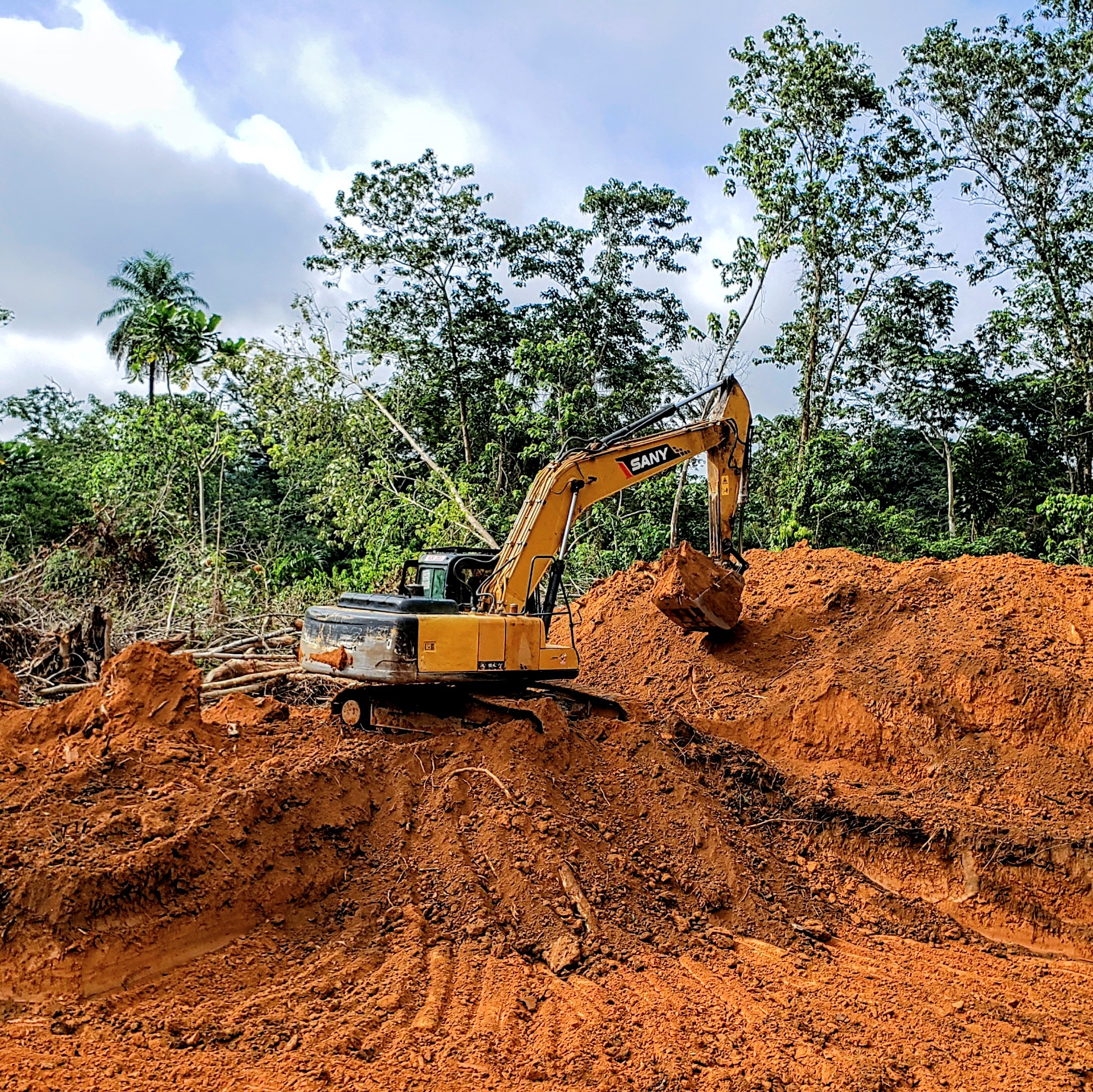
One great thing about working in Sierra Leone is you don’t need permits as you do in BC. We were able to start digging with an excavator right away. With a combination of bulk sampling with the excavator and teams of local shaft diggers sampling was completed in less than a month. The gold grades within the channel were excellent and alluvial diamonds were also present.
Exploring a new area is always a welcome experience. As explorers, we are constantly striving to search different areas and locate mineable gold deposits. This exploration program in West Africa did not disappoint. It was quite a contrast to use the latest technologies in an area where people are still living in mud huts and cooking with charcoal. Some of the ancient techniques used in Sierra Leone are very efficient, such as the shaft digging technique. If we could get hundreds of workers to dig shafts in Canada for $10 per day imagine the ground that could be explored.
We managed to locate a very rich placer deposit containing minable quantities of gold and alluvial diamonds. This project was developed with the support and mutual benefit of the local chiefdom and communities. It was a great experience to share knowledge of different mining and exploration techniques and learn a few new ones as well.
Placer gold mining has been practiced for thousands of years with evidence dating back as far as 2600 BC in ancient Sumeria and Egypt. The technology required is minimal with only a gold pan you can refine gold in a placer deposit. The word “placer” comes from the spanish word meaning “pleasure”. Perhaps an allusion to the delight of finding precious metal in a river bank. The word was spread as gold bearing gravels were discovered in parts of North America colonized by Spain. In fact the discovery of gold the primary motivation for Spanish explorers to dig deeper and deeper into the newly discovered continent.
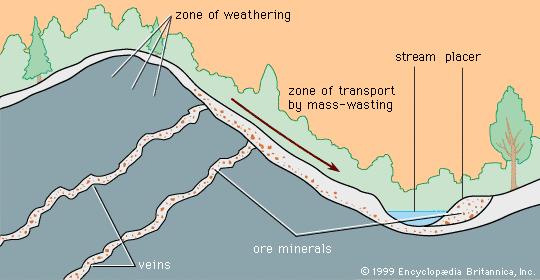
As we discussed in the part 1 and part2 gold is created in fantastic cosmic explosions. It has traveled across the universe and made up a small part of the material that the earth formed from. Tectonic and volcanic forces collected gold in concentrated lode deposits where it can be mined. The concept of how gold transfers from lode deposits to placer deposits is pretty straightforward. Rock holding the gold bearing veins or ore is slowly chiseled and broken by weathering and erosion. The erosive forces of water, wind, and ice transport rock fragments into drainage systems such as streams and rivers. Gold and other heavy minerals will settle out in areas in the stream where the water loses momentum or creates a trap. These traps form into placer deposits over time.
Placer deposition is driven by gravity. Gold is very dense, meaning that compared to another substance of the same volume it experiences a stronger pull of gravity. There are other principles of physics that apply to placer deposition. The property of inertia is the resistance of any physical object to any change in its state of motion. Less dense objects require less force to move them and in the case of a stream will travel farther and faster than heavy objects. Gold has a density that is twenty times that of water and about 8 times the density of sand. Another factor in the formation of placer deposits is Archimedes’ principle which states that the force of buoyancy on an object is equal to the weight of the displaced fluid. This principle was historically used to measure density of gold by Archimedes himself. As gold is many times more dense than water the force of buoyancy on submerged gold particles is much less than the force of gravity. So gold in a stream is held in place by gravity and resists movement due to its weak buoyancy and strong inertia.
There are several types of placer deposits. There are alluvial placers, eluvial placers, beach placers, eloian placers and paleo-placers. For each type of deposit there are miners who specialize in that type of deposit. All placer deposits have concentrated gold from its source in some kind of trap. The vast majority of the placer gold that is mined in the world is of the alluvial variety.
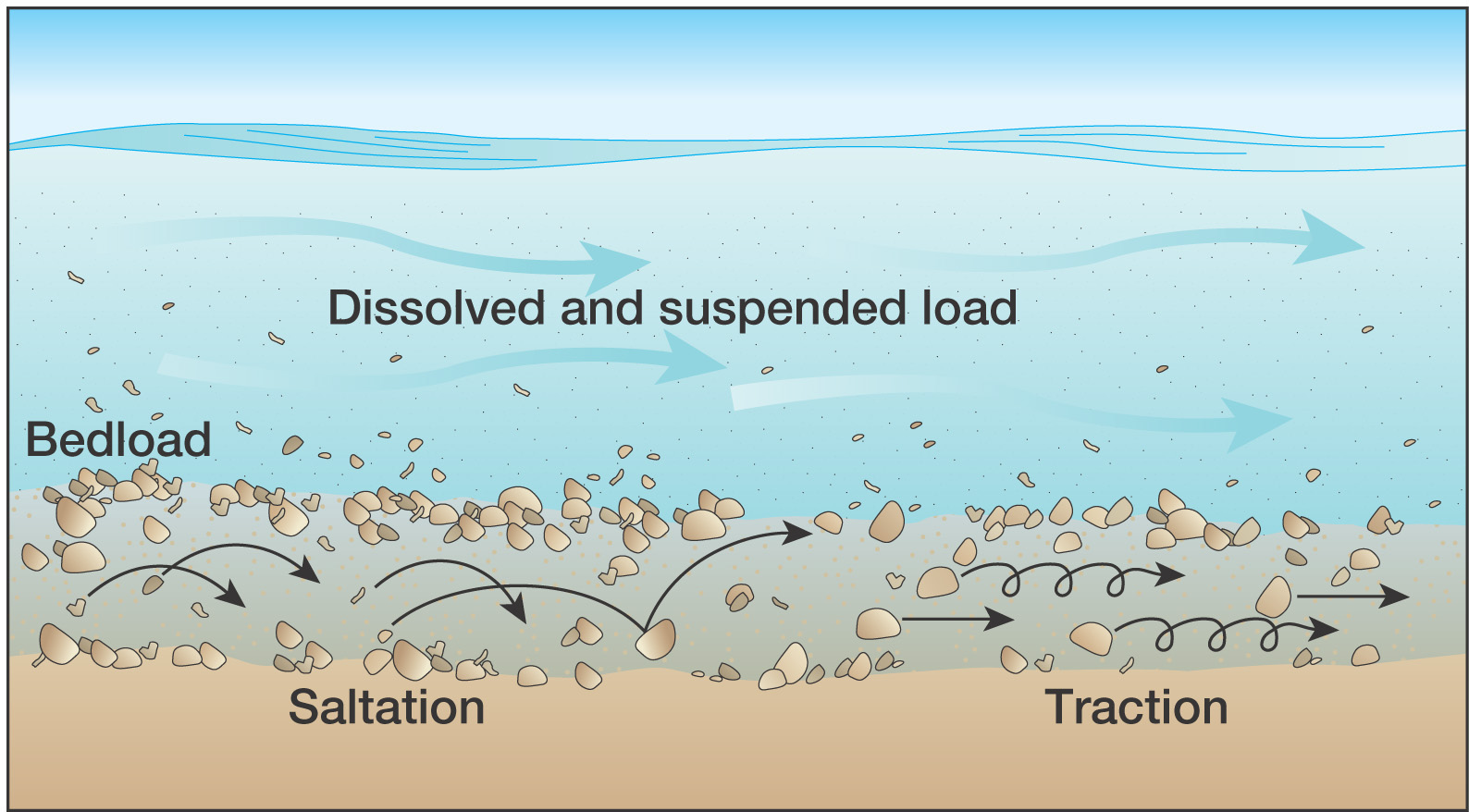
Alluvial placer deposits are formed in watercourses such as creeks, rivers, streams and deltas. The gold is eroded from lode deposits and carried into the watercourse through rains and melt. Once into a stream it can be moved great distances. Gold does not move easily in a stream due to the inertia and buoyancy forces described above. It takes many years for gold to make its way into a stream and to travel within it. The gold will move along the bottom of the stream until it reaches a point where the water loses velocity or it is physically trapped. Typically gold will accumulate on the inside bends of a river where the water velocity is lower. Large rocks or outcrops can create a natural riffle or eddy where the water slows down and dense material will accumulate. Waterfalls are another great trap for gold.
Alluvial placers can be broken into several groups. Flood gold is placer gold that moves during annual floods or other flood events. Gravel bars and upper sections of stream sediment are where flood gold is usually found. This type of deposit generally consists of small flake and flour gold since they move more rapidly than nuggets. Flood gold is actively being deposited and will replenish year after year
Streambed placer deposits are essentially the same as flood deposits except that they no longer move. Streambed placers are found in a current watercourse. These deposits typically consist of gravel that is settled in the stream bed. To produce a streambed placer you have to mine under the water. Techniques that can be used are sniping, suction dredge, or diverting the water using a dam such as a wing dam.
The third type of alluvial placer deposit is a bench placer. Bench deposits are part of the old stream bed before it cut into a deeper channel. Benches can contain huge amounts of gold if the river carried gold at that time. A bench is typically flat on top and may appear like steps coming down the valley side. Benches can be mined using conventional mining equipment since they are usually high and dry above the current river.
Eluvial placer also known as residual placer deposits are formed before any water transportation has taken place. These deposits form close the source of hard rock gold. Eluvial placers will contain much large particles of gold than other types because it takes a lot of energy to move large nuggets. Often quartz will be found with gold still attached in Eluvial placers. These types of placers are formed by weathering and decay of the host rock that holds gold. Areas where there is a lot of iron can break down rapidly as the iron oxidizes. The lighter overburden is generally washed away and unsorted gravel and heavy material is left in place. These deposits are generally small and very attractive to small miners they also are close to gold bearing veins which can be very exciting.
Beach placers are deposits that occur on the edges of large lakes or the ocean. The wave action on the beach is the mechanism that concentrates gold and other dense minerals. Gold can either be carried to the beach by an alluvial system or eroded directly by waves. A famous beach placer is the deposit in Nome, Alaska which is featured in the TV reality show “Bering Sea Gold”.
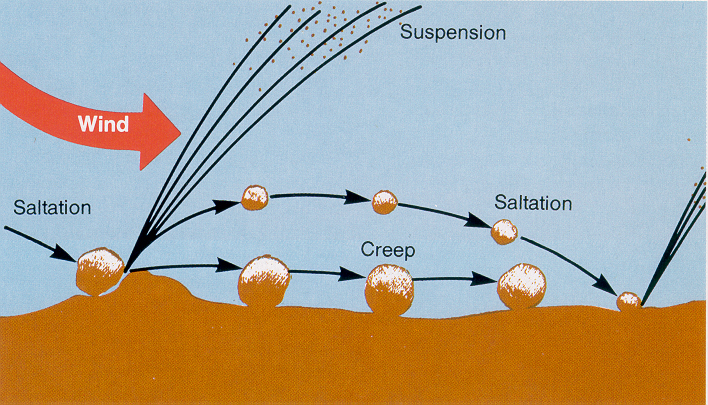
Eolian placers form in areas where wind is the main mechanism of erosion and not water. Eolian placers are similar to Eluvial placers in some ways, they occur close to the hard rock source, and are poorly sorted. Wind does a terrible job of moving gold. In Eolian placers the overburden is swept away by strong winds and leave the heavy ore behind. They occur primarily in desert regions such as the arid regions of Australia.
The last type is paleo-placer deposits. These are any of the above placer types that happened a long time ago. By a long time we are talking about millions of years. Paleo-placers were once placer deposits but over time they have been hidden and covered in sediment. There is often no sign at the surface of ancient river systems below. Paleo-placers can be ancient river channels, benches or sedimentary rock formed from old placers such as quartz pebble conglomerate. This kind of deposit can amount to huge quantities of gold and make you very rich. The largest known gold deposit in the world in Witwatersrand, South Africa is one of these. Over 1.5 billion ounces of gold has been mined in Witwatersrand. Deposition occurred approximately 3 billion years ago in Witwatersrand, and it is estimated that 50% of all the gold mined on earth came from that deposit.
That’s the story of where placer gold came from. It was created in incredibly powerful explosions from dying stars. It made up the earth as it formed and was squeezed into concentrated deposits by volcanic processes. The veins eroded into river systems and hopefully made its way into your gold pan. Gold’s unique properties of density and its resistance to corrosion and most other chemical reactions allow it to build into the kind of deposits that we can find and mine.