Have you ever taken a risk?
It sounds like a simple question, but if you look closely it reveals something about the kind of person you are. Some people organize their lives around reducing uncertainty. They want clear instructions, reliable systems, predictable outcomes.
And then there are the others.
The ones who are drawn toward uncertainty.
History, if you look at it carefully, belongs almost entirely to that second group.
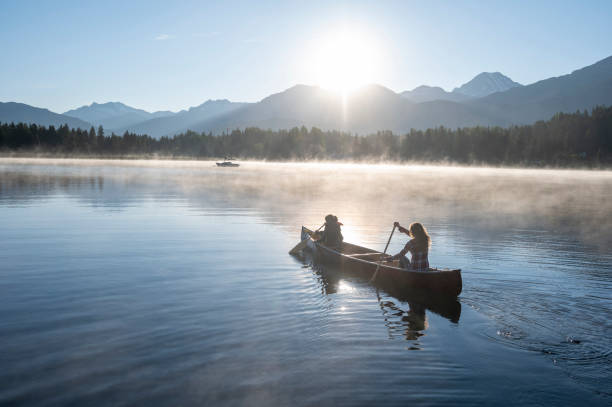
But if you stretch your view back far enough, risk begins to look less like an exception and more like the default setting of our species. For most of our existence, the world did not present itself as a series of guarantees. It presented signals. Clues scattered across landscapes that hinted at possibilities.
A patch of greener vegetation suggesting water beneath the soil.
A flock of birds moving in a particular direction, hinting at land over the horizon.
A bend in a river where heavy minerals accumulated in the gravel.
Or a faint glimmer in a pan that might be gold.
The people who noticed those signals survived and prospered. Over time, the habit of searching became something deeper than strategy. It became part of how the human brain works. To understand that instinct, it helps to begin somewhere small.
Why do children prefer to hunt for Easter eggs instead of simply being handed the chocolate?
The chocolate is identical either way. The outcome is identical. Yet the moment the eggs are hidden, the yard transforms into something different.
Children move across it like explorers.
They scan the grass. They check behind bushes and beneath benches. Their attention sharpens. They notice flashes of color others miss.
The hunt becomes the experience. And when one of them finds an egg, the excitement that follows is strikingly intense for something wrapped in foil. Because what the child has discovered is not simply chocolate.
They have revealed something hidden.

That moment activates a very old circuit in the brain. Neuroscientists studying motivation have discovered that dopamine, the neurotransmitter commonly associated with pleasure, behaves in a curious way. It does not primarily spike after a reward arrives. It spikes when the brain detects the possibility of reward. The key word is possibility.
When something valuable might exist in the environment, dopamine rises sharply. Attention narrows. Curiosity intensifies. The brain prepares to search.
This is sometimes called the exploration circuit. It links dopamine producing neurons in the midbrain with areas of the cortex responsible for planning and attention. When uncertainty combines with potential opportunity, the system activates.
The result is a powerful feeling that explorers across history have described in remarkably similar terms.
Curiosity.
Anticipation.
The sense that something might be just ahead.
Which brings us to gold.
Gold has always had a peculiar ability to pull explorers into unknown landscapes. Unlike many resources, gold rarely sits out in the open. It hides in subtle geological patterns. It collects in ancient riverbeds, bedrock cracks, and layers of gravel shaped by long forgotten floods.
Finding it requires attention.
It requires reading the landscape.
And it requires persistence.
Long before the Klondike, explorers searching for gold reshaped an entire continent.
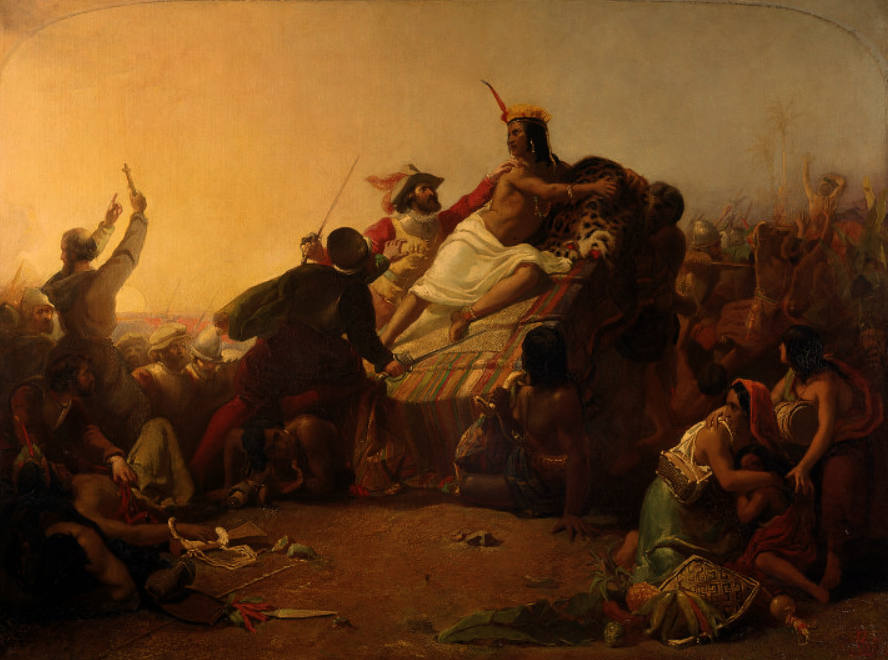
When Spanish explorers arrived in the Americas in the sixteenth century, they carried with them stories of immense wealth hidden somewhere in the interior. The legend became known as El Dorado, the lost city of gold.
Whether the city actually existed mattered less than the possibility that it might.
Expeditions pushed deeper into jungles and across mountain ranges searching for it. In the process they mapped rivers, crossed the Andes, and encountered civilizations like the Inca.
The Inca themselves had mastered a sophisticated relationship with gold. For them it was not currency but something closer to sunlight made solid, a sacred material used in temples and ceremonial objects.
The Spanish saw it differently.
To them it represented wealth.
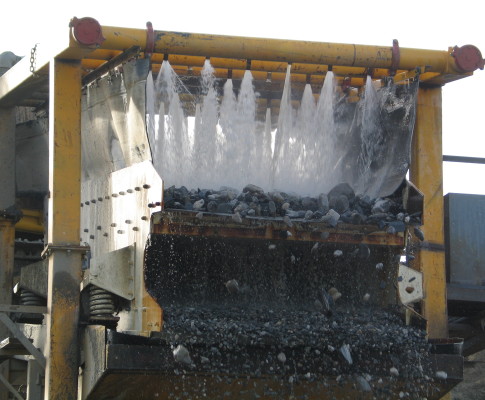
And so they developed strategies for finding it. They followed river systems inland, studying the way water moved through landscapes. They learned that gold tended to settle in certain places: inside bends of rivers, behind obstacles, and in layers of gravel where heavy minerals accumulated. They also left us some of the vocabulary miners still use today.
Placer deposits are concentrations of heavy minerals like gold that accumulate in sediments through the action of water.
The word placer comes from Spanish.
It shares its linguistic root with the word for pleasure.
There is something quietly fitting about that connection. The pleasure of finding placer gold is not only in the gold itself. It is in the act of finding it.
The gold rushes of the nineteenth century followed a pattern that now feels almost inevitable. A small discovery would be made, often by a handful of prospectors working a creek, and the news would begin to travel. At first slowly, then all at once. Within weeks or months thousands of people would be moving toward a place most of them had never seen.
It began in California in 1848 at Sutter’s Mill. Soon the rivers of the Sierra foothills filled with miners crouched along gravel bars, panning and sluicing. Ships arrived in San Francisco only to have their crews abandon them for the diggings.
The pattern repeated itself again and again across the west.
In 1858 gold was discovered along the Fraser River in British Columbia, and prospectors rushed up the canyon testing every bar of gravel they could reach. The search pushed deeper into the interior during the Cariboo rush, where camps like Barkerville appeared almost overnight. When new discoveries were made in the Cassiar and later the Omineca districts, the frontier shifted again, following the signals of gold farther north.
When gold was discovered in the Yukon in 1896, tens of thousands of people began traveling north. They crossed mountain passes carrying enormous loads of supplies. They built camps along frozen creeks and dug shafts through permafrost.
The earliest miners focused on the creek bottoms of Bonanza and Eldorado. There they found astonishingly rich deposits of gold concentrated in the gravel.
But the story did not end there.
The first miners had found the obvious gold.
The gold that was easiest to see.
More experienced prospectors began noticing something else. The hills above the creeks contained layers of gravel that did not belong to the modern river system.
These were remnants of ancient channels.
Old rivers that had once flowed across the landscape at higher elevations before erosion carved the valleys deeper.
One of the prospectors who recognized this was “Caribou Bill” Seathing, a veteran of earlier northern mining camps in the Cariboo and Cassiar districts. Seathing understood that if those ancient rivers had carried gold, their gravels might still contain it. So he began exploring the hills above Bonanza Creek. And he found gold there too.
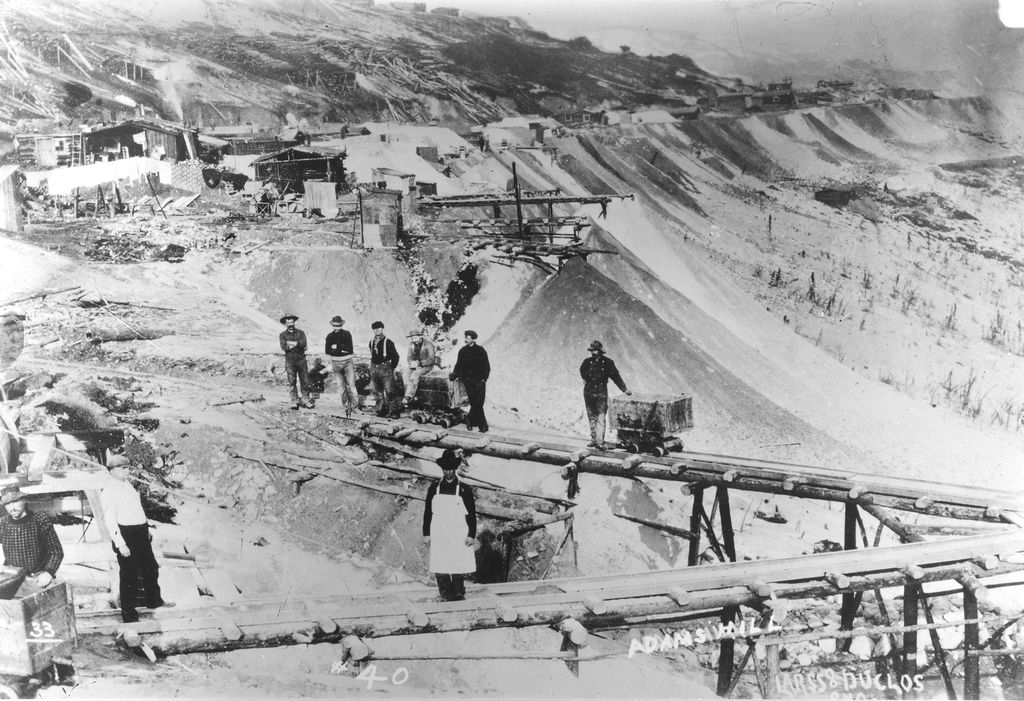
This discovery sparked a second wave of exploration across the hillsides overlooking the valley. Miners began referring to these areas collectively as the hills of Bonanza. Among the most famous were Cheechako Hill, Gold Hill, French Hill, and Adams Hill.
The names themselves tell part of the story.
Cheechako was the northern nickname for newcomers who lacked experience. The joke was that only a cheechako would dig on the hillside instead of the creek. Until they hit rich ground.
Gold Hill quickly became one of the richest bench deposits in the district.
French Hill was heavily worked by French Canadian miners.
Adams Hill revealed another fragment of the ancient river system.
Geologically the picture became clear.
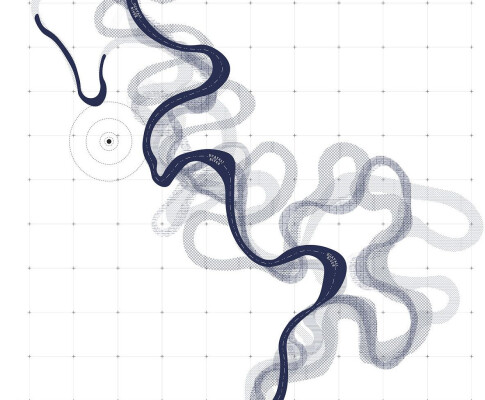
An older Bonanza River had once flowed at a higher elevation, depositing gold within its gravels. Later erosion carved the valley deeper, leaving pieces of that original channel stranded along the hillsides.
Below them, the modern creeks continued cutting downward. The result was a layered placer system. Deep creek pay streaks. Bench gravels halfway up the valley. High channel remnants perched along the hills.
The miners who discovered the hills were not simply lucky.
They were paying attention.
They were following signals in the landscape.
And they continued searching after others believed the gold had already been found.
That pattern repeats across every frontier humans explore.
Take the search for the Titanic.
When oceanographer Robert Ballard set out to locate the wreck in 1985, the search area in the North Atlantic was enormous. Looking directly for the ship would have been like searching for a needle in a dark ocean.
So Ballard changed the strategy.
Instead of searching for the ship, he searched for the debris field that must surround it.
A camera sled was lowered to the ocean floor and the support ship began moving in a grid pattern, sweeping the seabed strip by strip, much like mowing a lawn.
Ballard spent weeks scanning empty seabed. Then suddenly something appeared.
A boiler.
A signal.
Following the debris trail eventually led to the wreck itself. The discovery looked dramatic when it appeared on television. But it was built on patient strategy.
Search the grid.
Follow the clues.
Space exploration uses similar logic.
Astronomers rarely see distant planets directly. Instead they search for subtle signals in the light of distant stars. If a planet passes in front of a star, the star’s brightness dims slightly. If a planet tugs on a star gravitationally, the star wobbles.
These tiny signals reveal worlds that would otherwise remain invisible.
Even the search patterns used by planetary rovers on Mars resemble grid exploration. Instruments scan the terrain methodically, sampling soil, analyzing rock chemistry, and building maps that reveal patterns beneath the surface.
Across oceans, planets, and river valleys, exploration follows a surprisingly similar structure.
Look for signals.
Search systematically.
Follow anomalies.
The creeks of the Klondike have been mined for more than a century. Yet new discoveries still happen. Modern geophysicists and geologists now use tools that earlier miners could never have imagined.
GIS mapping allows explorers to reconstruct ancient landscapes from digital elevation models. Satellite imagery reveals subtle features in terrain that hint at buried river systems. And new geophysical techniques allow explorers to see beneath the surface without digging.
One example is HVSR (horizontal to vertical spectral ratio analysis) seismic technology that we use today. Instruments placed on the ground record natural vibrations in the Earth. By analyzing those vibrations, geophysicists can estimate the depth of sediment and the shape of bedrock beneath it.
Ancient river channels often appear as deep troughs carved into bedrock and filled with gravel. In other words, the buried rivers that carried gold thousands or millions of years ago can still be mapped. Even in landscapes that have been mined for over a hundred years.
Exploration is not only about tools or techniques. It is about a way of seeing.
The philosopher William James once wrote that attention determines our experience of reality. It is a deceptively simple idea. The world around us contains vastly more information than any brain could possibly process. Every moment carries an overwhelming flood of sights, sounds, textures, movements, patterns, and possibilities. If we tried to absorb all of it at once, our minds would collapse under the weight of it.
So the brain solves the problem with a kind of ruthless efficiency.
It filters.
James described attention as the process by which the mind selects one small portion of reality and elevates it above the rest. Everything else fades into the background. Not because it disappears, but because we stop noticing it.
Explorers notice differently.
They linger on anomalies.
They follow faint patterns.
They move toward uncertainty instead of away from it.
And sometimes, when those signals are followed far enough, they discover something extraordinary.
Gold in a hillside.
A shipwreck beneath the sea.
A reef in the ocean.
A planet orbiting a distant star.
When the eggs are hidden, the lawn becomes a landscape of possibility. The children spread out across it scanning for clues.
A flash of color. A shape in the grass. Then suddenly someone sees something.
Discovery.
In that moment something ancient in the brain settles into place. The possibility that first caught the mind’s attention has turned into something real. A signal has become a finding.
The experience is strangely universal. A child lifting an egg from the grass. A prospector watching a bright fleck of gold appear in the bottom of a pan. An oceanographer noticing a shape on the seafloor that turns out to be a ship lost for a century. An astronomer seeing the faint dimming of a star that reveals a planet no one has ever seen.
Different landscapes. But the same instinct.
Humans have always been drawn toward places where the pattern of the world suggests something more might be there.
And somewhere, in a valley shaped by an ancient river and now traced by modern instruments, the next discovery is already part of the landscape.
Waiting for someone curious enough to start looking.